
CERN: “God” Has Been Found. Now What?
 Ibironke Babalola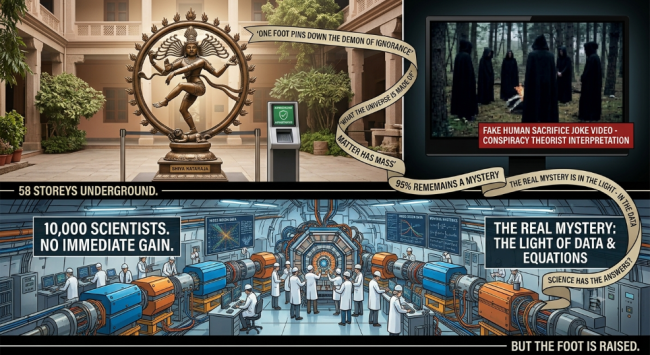
FEELNUBIA | SCIENCE & SOCIETY
A follow-up to “The Most Ambitious Experiment Ever” (Feelnubia, 2010)
In 2010, this publication asked a question that most of the world’s media was too polite (or afraid) to ask aloud: Then what? A $9 billion machine buried 58 storeys underground, built by 10,000 scientists from 100 countries, is being used to simulate the Big Bang. It is searching for something called the God particle. The world did not vote on this. And if something goes wrong, there will be no appeals process. The clock ticks. Then what?
We are now fifteen years on from that article, and the answer to “then what?” has arrived – in stages, and not without its share of theatrics: The God particle was found. A “fake human sacrifice” was filmed on the premises. Having found the thing they were looking for, scientists are now hunting for something even more elusive than the thing they already found. And somewhere in the middle of it all, a beautiful bronze statue of a Hindu god keeps standing in a Swiss courtyard, watching it all unfold; while the conspiracy theorists lose their minds trying to piece it all together.
Let us take this one development at a time.
Part One: They Found It
On 4 July 2012 (a date that felt almost theatrically chosen), physicists at CERN announced that the Higgs boson had been detected. Peter Higgs, the elderly Scottish physicist who had predicted its existence nearly fifty years earlier, sat in the audience and wept. He was awarded the Nobel Prize in Physics the following year, alongside Belgian physicist François Englert. The original “God particle”, which is believed to be the particle of particles that interacts with other particles to form matter had finally been found.
So the machine worked. The world did not implode. The drunken man did not totter. 10,000 scientists were not, in fact, wrong. Yet.
But here is the part nobody adequately warned us about: finding the Higgs boson did not close the book. It opened a new one – and this new book is considerably stranger, and more humbling, than the last.
The Higgs boson was the final missing piece of what physicists call the Standard Model – the grand unified theory of all known matter and forces. Completing it was one of the great intellectual achievements of human civilization. And the reward for completing it was the immediate, unavoidable realization that the Standard Model describes only about 5% of the universe. The remaining 95% (dark matter, dark energy, the forces we cannot yet see) remains almost entirely beyond reach.
The Tower of Babel was completed. The builders reached a new height – and found that the sky was not a ceiling but an infinite opening.
Part Two: The Sacrifice Video
If the discovery of the Higgs boson was the serious chapter, what followed in 2016 was the absurdist footnote.
On 11 August 2016, a video surfaced online under the breathless title: “Murder At Cern – Disturbing Human Sacrifice Video Surfaces.” Filmed at night from a window overlooking CERN’s main courtyard in Geneva, it showed a group of people in dark hooded cloaks gathering in front of the facility’s famous bronze statue of the Hindu deity Shiva. A woman in white lay on the ground before them. One of the figures produced a knife and stabbed her. The person filming let out a string of expletives and ran.
The video spread across the internet within hours, picked up by conspiracy-oriented websites as proof of exactly the kind of occult activity they had long suspected was taking place inside the world’s most powerful physics laboratory.
CERN launched an internal investigation. The outcome was not, it said, a portal to another dimension or a Satanic ritual sacrifice. It was a prank – staged by CERN employees with access badges who had, in the characteristically understated words of CERN’s official spokesperson, “let their humour go too far.” The central figure was subsequently identified as Yan Voinier, a known employee of the organization. CERN confirmed that the video was entirely staged, issued a statement that it “does not condone this kind of hoax, which may cause misunderstandings about the scientific nature of our work,” and moved on.
And yet — the video continued to circulate. It is still circulating.
Why? Because conspiracy theories do not require evidence. They require anxiety. And CERN has been generating anxiety in the general public since the moment its existence became widely known. The original Feelnubia article was evidence enough of that: even a thoughtful, good-faith observer could look at the LHC in 2010 and ask, with genuine unease, whether humanity had the right to conduct this experiment without the consent of everyone it might affect.
Into that existing well of public unease, CERN’s own employees cheerfully dropped a lit match – and seemed surprised by the fire.
The prank was real. The sacrifice was fake? The anxiety remains legitimate.
Part Three: Why Is There a Statue of Shiva at CERN?
This is, genuinely, the most interesting question in the whole story – and the conspiracy theorists have managed to make it boring by smothering it in nonsense.
The two-metre bronze statue of Nataraja (Shiva as the Cosmic Dancer) was unveiled at CERN on 18 June 2004. It was a gift from the Government of India to mark the country’s decades-long association with CERN, which began in the 1960s. India is an associate member state of CERN, and the gift was presented at a formal ceremony by the Indian Ambassador to the WTO and the Chairman of India’s Atomic Energy Commission. This is all a matter of public record.
But the reason the Indian government chose Nataraja specifically (rather than, say, a better suited statue of a celebrated Indian scientist) is where the real story lies.
In Hindu theology, Nataraja represents Shiva performing the Tandava – the cosmic dance of creation, preservation, and destruction. It is one of the most ancient images of the universe as a dynamic system: not a fixed object but a perpetual rhythm, a cycle with no beginning and no end. The drum in Shiva’s upper right hand beats the pulse of creation. The flame in his upper left hand signals destruction. The demon beneath his foot is Apasmara – the spirit of ignorance, crushed underfoot by the god of knowledge and transformation.
Now consider what CERN’s physicists are actually doing in that machine underground. They are smashing particles together at close to the speed of light in order to observe what happens in the tiny fraction of a second before matter and energy settle into the forms we recognize. They are, in other words, studying the moment at the edge of creation – the boundary between something and nothing, between order and chaos, between existence and its absence.
The metaphor was not invented by conspiracy theorists. It was drawn explicitly by the physicist Fritjof Capra, whose 1975 book The Tao of Physics argued that the imagery of Eastern philosophy (and Shiva’s dance in particular) was a more intuitive representation of subatomic reality than any Western framework had produced. A plaque installed beside the CERN statue quotes Capra directly: Indian artists, he wrote, created images of dancing Shivas centuries ago; modern physicists have used the most advanced technology to portray the same patterns of the cosmic dance. The metaphor, the plaque concludes, unifies ancient mythology, religious art, and modern physics.
Carl Sagan made a similar observation: that Hinduism is the only world religion whose cosmological time scales (cycles of creation and destruction lasting billions of years) correspond, even if accidentally, with those of modern scientific cosmology.
The Shiva statue, in short, is not merely purported evidence of occult activity at CERN. It is evidence of something considerably more interesting: a 1,300-year-old Tamil bronze-casting tradition, commissioned by the government of a nation that has contributed enormously to the theoretical foundations of modern physics, placed at the world’s premier physics laboratory to honour an insight that cuts across the boundary between science and metaphysics.
What the conspiracy theorists have missed is not a secret. It is the beauty of what is sitting in plain sight.
Part Four: What Are They Actually Looking For Now?
With the Higgs boson found and the Standard Model complete, one might reasonably ask why CERN continues to operate – and why it is now proposing to build a machine nearly four times as large at an estimated cost of $17 to $20 billion.
The short answer is: dark matter.
Dark matter (also known as exotic or invisible matter) is the name physicists give to the 27% of the universe that appears to exert gravitational influence on visible matter (holding galaxies together, shaping the large-scale structure of space) but that does not interact with light and has never been directly detected. It is not in any periodic table. It does not show up in any detector yet built. We know it exists because the universe would fly apart without it. We do not know what it is.
And then there is dark energy (the force believed to be driving the accelerating expansion of the universe), which accounts for roughly 68% of everything that exists. Also known as the ‘cosmological constant’ or ‘vacuum energy’, we understand it even less than dark matter.
So: the Standard Model (the most precisely verified theory in the history of science) describes only about 5% of the universe. The remaining 95% remains, in the most literal sense, a huge mystery. With an annual budget of c. $5 billion for operations and upgrades, an estimated $6 billion to build the Large Hadron Collider (LHC), after 70 years in operation, CERN has spent a conservative estimated of $360 billion. While things get more and more curious, tt would appear that the CERN paradox is that ‘There are more questions than answers, and the more that I ask, the less I know.’
CERN’s physicists are now hunting for particles predicted by a theoretical framework called Supersymmetry — SUSY — which proposes that every known particle has a heavier “partner” particle not yet observed. If these partner particles exist, the lightest of them could be the dark matter particle that has eluded detection for decades. So far, Run 2 of the LHC (2015–2018) has found no direct evidence for supersymmetric particles, and many of the mass ranges once considered most promising have been effectively ruled out. But supersymmetry has not been ruled out. The hunt continues into Run 3.
They found the God particle, and immediately realized they are living in a universe they understand almost nothing about. The ambition has not shrunk. It has expanded to match the ignorance.
Part Five: The Questions That Have Not Gone Away
The 2010 Feelnubia article raised two questions that remain entirely unanswered, regardless of what has happened at CERN since.
The first is the question of global consent and scientific accountability. When a project of this scale is undertaken, who speaks for the rest of us? The people who might be affected by it are not merely the physicists at the controls. They are seven billion non-physicists who did not vote, were not consulted, and whose continued existence is (at least in theory) implicated in the outcome. This is not paranoia. It is a legitimate question about democratic governance in the age of big science. The fact that CERN has now operated for decades without incident does not dissolve the question; it merely defers it.
The second is the question of priorities. The proposed Future Circular Collider would cost upwards of $17 billion. Global hunger could be addressed, according to the United Nations, for an estimated $40 billion per year. Clean water access for all currently unserved communities would cost roughly $114 billion in total infrastructure. These numbers do not make the FCC indefensible — there are arguments for long-term scientific investment that have real merit. But they do make the moral arithmetic uncomfortable, and the 2010 article was right to make us feel that discomfort.
There is also a third question that the 2010 article could not fully see, but which the Shiva statue raises implicitly: where is Africa in this story?
India’s centuries-old intellectual tradition (its cosmological philosophy, its mathematical heritage, its modern physics community) is formally present at CERN: in the statue, in the plaque, in associate membership, in hundreds of Indian scientists contributing to the most ambitious science on earth. South Africa has been the most active African participant in CERN’s work through iThemba LABS, and there are growing efforts to build physics capacity across the continent. But Africa’s share of those 10,000 scientists does not yet reflect either its population or its intellectual history. A continent that gave the world its first mathematical tools – the Ishango bone, carved 25,000 years ago on the shores of what is now the Democratic Republic of Congo – is underrepresented at the frontier of human knowledge.
That is a problem worth more column inches than any fake sacrifice video.
Coda: What the Dance Tells Us
Stand in that Swiss courtyard, if you can get a badge. Look at the statue.
Shiva dances inside a ring of fire. One hand holds a drum: creation. One hand holds a flame: destruction. One foot pins down the demon of ignorance. One foot is raised in perpetual motion, in the gesture known as Abhaya: do not be afraid.
Beneath that statue, 58 storeys underground, 10,000 scientists from countries that have spent centuries in conflict with one another are trying (for no immediate commercial gain, with no guaranteed outcome) to understand what the universe is made of and how it works. They found the Higgs boson. They confirmed that matter has mass for reasons we can now at least partially explain. They discovered, in doing so, that 95% of the universe remains a mystery.
And then some of them dressed up in cloaks and filmed a fake human sacrifice as a joke.
Scientists are, after all, people.
The conspiracy theorists who watched that video and concluded that CERN is a site of occult activity are missing what the statue has been trying to tell them all along: the real mystery is not what happens in the dark. It is what happens in the light – in the data, in the equations, in the measurements that tell us that the universe is at once more comprehensible and more incomprehensible than any generation before us has understood it to be.
In 2010, Feelnubia asked: “Perhaps science has the answers to the questions that science poses?”
Fifteen years on, the answer is: not yet. But it is the only honest attempt being made.
The clock still ticks. The dance continues. The demon of ignorance is still, for now, winning.
But the foot is raised.
A follow-up to “The Most Ambitious Experiment Ever” (March 30, 2010)
