
Africa’s People: Ethnic Groups That Shape The Continent (East Africa)
 FN Educational Resources
The Great Crossroads
The Oromo — Africa’s Largest Ignored Nation
The Oromo are Ethiopia’s largest ethnic group and one of the continent’s most populous peoples. With around 41 to 45 million speakers of the Oromo language, they represent over 35% of Ethiopia’s population. Yet for much of the 20th century, their language and culture were actively suppressed.
Their governance system, the Gadaa, is extraordinary. It organises all of Oromo society into generational classes that rotate through military, political, and civic roles on an eight-year cycle. It is one of the world’s most sophisticated indigenous democratic systems — and it predates the Ethiopian state by centuries.
The Gadaa system was not merely political — it was a professional rotation. Men moved through formally defined roles as warriors, administrators, and elders in sequence, making military service, governance, and civic leadership structured professions with defined entry and exit. Oromo pastoralists and farmers occupied the fertile highlands and lowlands of the Horn, and their cattle herders developed specialist skills in animal husbandry across dramatically varied climates. Oromo craftswomen were accomplished potters and weavers. Their healers — called raagaa, who also served as spiritual leaders and diviners — held considerable community authority, combining medical and prophetic roles into a single prestigious profession.
The Amhara — The Empire Builders
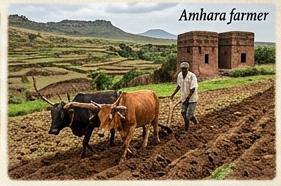
The Amhara have shaped Ethiopian history for over 2,000 years. Numbering around 20 to 21 million people, they formed the political and military backbone of the Ethiopian Empire. Their script, derived from the ancient Ge’ez alphabet, is one of the world’s few indigenous African writing systems still in everyday use. Their Ethiopian Orthodox Christianity dates back to the 4th century AD, making Ethiopia one of the world’s earliest Christian nations.
The professions that sustained the Ethiopian Empire were overwhelmingly Amhara in character. The debtera — a class of trained church scholars who were simultaneously scribes, musicians, and ritual specialists — formed the Empire’s literate professional core. Amhara administrators and military commanders staffed the imperial bureaucracy that governed one of Africa’s few states to successfully resist European colonization. The Ethiopian Empire’s army, under emperors from Yekuno Amlak to Haile Selassie, maintained a professional officer class whose tactical victories — most famously over Italy at Adwa in 1896 — reshaped world history. Amhara farmers, practicing a mixed crop-and-livestock agriculture on the Ethiopian highlands, also sustained one of Africa’s densest and most productive rural economies.
The Somali — Poets of the Horn
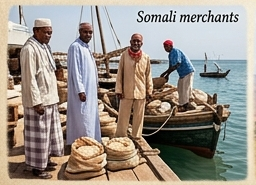
The Somali occupy the entire Horn of Africa — Somalia, Djibouti, eastern Ethiopia, and northern Kenya. They number roughly 27 million people total. Few ethnic groups in Africa are as culturally cohesive: a single language, a shared Islamic faith, and an oral poetry tradition that rivals the world’s great literary cultures all bind them together.
Somali gabay poetry is technically demanding and philosophically rich. Poets have historically held enormous social prestige, acting as diplomats, historians, and political commentators all in one.
Trade was the Somali’s defining professional heritage. The ancient port cities of Zeila and Mogadishu connected East Africa, Arabia, and India in a maritime commercial network that operated for over a thousand years. Somali merchants exported frankincense, myrrh, livestock, and slaves, and imported textiles, ceramics, and metalwork from across the Indian Ocean world. The Somali Sultanates — including the Ajuran, Adal, and Geledi — maintained professional armies, administrative courts, and hydraulic engineers who built the irrigation systems that made the Jubba and Shabelle river valleys agriculturally productive. Camel herding remained the pastoral profession of prestige across the interior, while coastal communities sustained specialist fishermen, boat builders, and long-distance merchant sailors.
The Maasai — Guardians of the Rift Valley
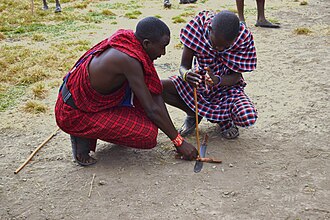
With just over 2 million people straddling Kenya and Tanzania, the Maasai are small in number but enormous in cultural presence. They are Nilotic-speaking pastoralists who have preserved their semi-nomadic lifestyle, their beaded jewellery, their red shúkà cloth, and their famous jumping dances — the adumu — in the face of intense modernising pressure.
For the Maasai, cattle are everything. Wealth, social status, ritual, and identity all flow from the herd. It is not just tradition. It is a philosophy of life.
The Maasai organised their professional lives around the age-grade system. Young men in the moran (warrior) grade served a formal military function — protecting herds, raiding rival cattle, and patrolling territorial boundaries — before graduating into elder roles as community administrators and judges. It was, in effect, a professional military service with a defined career arc. Maasai women were the specialist builders of the enkiama homesteads, constructing homes from a mixture of mud, sticks, grass, and cattle dung, and the primary producers of the elaborate bead jewellery that communicated age, social status, and marital standing. The Maasai also traded cattle, hides, and blood products with neighbouring farming communities, filling the role of specialist pastoralists in a broader regional economy.
The Swahili — Africa’s Cosmopolitans
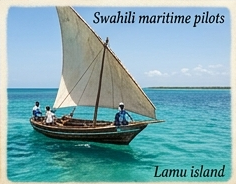
Along the Indian Ocean coast of Kenya, Tanzania, and Mozambique, a unique civilisation emerged over a thousand years of maritime trade. The Swahili people blended Bantu African foundations with Arabic, Persian, and Indian influences into something entirely their own.
Their language, Kiswahili, became East Africa’s most widely spoken lingua franca — now used by over 200 million people across the continent. Their stone towns, like Lamu and Kilwa, were prosperous trading cities when medieval Europe was still rebuilding from the Dark Ages.
The Swahili were professional merchants and maritime specialists above all else. Swahili dhow captains and navigators read the Indian Ocean monsoon winds with precision, making seasonal voyages to Arabia, Persia, India, and the Malay world. The city of Kilwa Kisiwani, at its medieval peak, was described by Ibn Battuta as one of the most beautiful cities in the world — a testament to the wealth generated by Swahili merchants who taxed and controlled the gold and ivory trade flowing from the African interior to the sea. Swahili stonemasons built the coral-stone architecture distinctive to the coast. Craftsmen produced fine cotton textiles. The professional class of Islamic scholars and judges — the kadhi — administered law and education in the stone towns, forming the intellectual elite of a cosmopolitan maritime civilisation.
The Ganda — Architects of Buganda
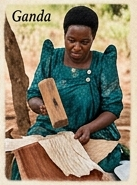
The Ganda are Uganda’s largest ethnic group, numbering around 6 million people, and the country itself takes its name from their kingdom — Buganda. This highly organised monarchy, which developed from around the 13th or 14th century, built one of East Africa’s most sophisticated political institutions. It maintains a reigning Kabaka (king) to this day. The current Kabaka, Ronald Mutebi II, holds enormous cultural and political influence in modern Uganda.
Buganda’s sophistication lay in its professional administrative class. Unlike many African kingdoms governed through hereditary chiefs, Buganda developed a meritocratic system in which the Kabaka could appoint and dismiss chiefs — creating a class of professional administrators who owed their positions to royal favour rather than birth. Ganda canoe builders and fishermen worked Lake Victoria with specialist skill, and the kingdom’s bark cloth makers — producing the distinctive reddish-brown olubugo cloth from fig tree bark — supplied both domestic use and regional trade. Buganda also maintained a professional standing army and a navy of war canoes that dominated Lake Victoria, giving the kingdom military reach across the region’s most important waterway.
Now, let us meet the people groups of Southern Africa
Population figures are approximate and drawn from current ethnographic and census data. Estimates vary across sources due to the complexity of ethnic identity, cross-border populations, and incomplete census data in some regions.
Recommended:


