
Custodians of Looted Heritage? The Foreign Museums Holding African Artefacts
 Ibironke Babalola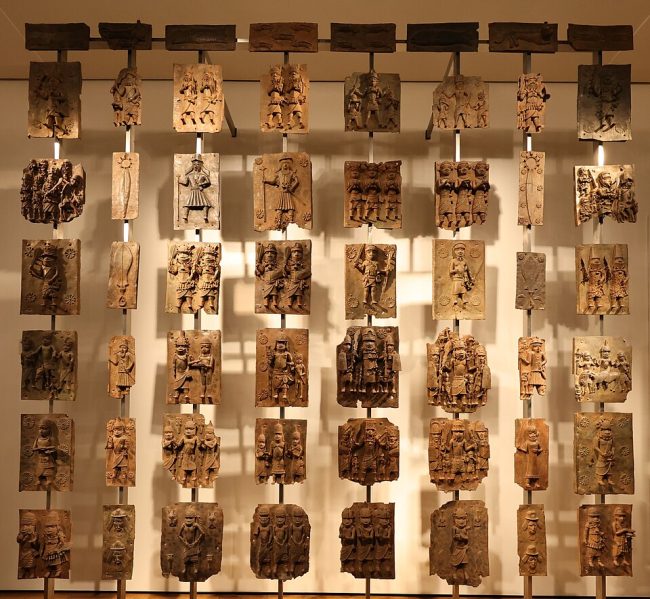
For more than a century, some of the finest achievements of African art and craftsmanship have sat behind glass in London, Berlin, Paris, Brussels, and New York rather than in Lagos, Kinshasa, Abomey, or Dar es Salaam. An estimated 85–90% of sub-Saharan Africa’s material cultural heritage is believed to lie outside the continent, most of it acquired during the roughly 1885–1960 colonial period. Five institutions anchor this story more than any others. Here is what they hold, how they got it, what it might be worth, and what is actually happening about giving it back.
1. The British Museum, London
What it holds: The British Museum cares for more than 900 objects from the historic Kingdom of Benin , the single largest collection of “Benin Bronzes” in the world. These are cast brass and bronze plaques, commemorative heads, ivory and coral regalia, and animal and human figures made from at least the 1500s onward by a specialist guild working for the Oba (king) of Benin in what is now Edo State, Nigeria. The Museum also holds the Parthenon (Elgin) Marbles and Maqdala treasures looted from Ethiopia in 1868, but the Benin material is the largest African holding at stake.
How they got there: In 1897, a British force razed Benin City in the “Benin Punitive Expedition,” sent Oba Ovonramwen into exile, and looted an estimated 3,000–4,000 works of art from the royal palace, in part to help finance the operation. Some pieces went to Queen Victoria; most were auctioned off or distributed to British and European museums.
Financial value: Precise figures are hard to pin down because the British Museum has never had its collection independently appraised for sale, and it argues the works are priceless heritage rather than assets. The auction market gives a sense of scale: a Benin bronze head sold for £10 million ($13 million) in a private sale in 2015, and Sotheby’s sold one for £4.7 million in 2007. With roughly 900 Benin objects in its keeping (some far more significant than others) informal estimates of the collection’s aggregate market value run into the hundreds of millions of dollars, though the museum itself does not publish such a figure and many pieces would likely never come to market at all given the ethical controversy now attached to selling them.
Attempts to return them: Nigeria has formally sought the bronzes’ return since shortly after independence in 1960, with a written government request submitted again in October 2021. The British Museum is legally barred from deaccessioning objects under the British Museum Act 1963 and the Heritage Act 1983, and its director has been openly resistant to restitution, arguing the collection represents three centuries of “accumulated heritage” that shouldn’t be undone. Instead, the museum has offered loans and collaborative programmes , including funding for the archaeological work behind Nigeria’s new Edo Museum of West African Art (MOWAA). Nigeria has generally rejected loans as an inadequate substitute for ownership transfer, since loaned objects can always be recalled. The pressure has intensified as peer UK institutions (Cambridge’s Museum of Archaeology and Anthropology (around 116 objects), the Horniman Museum (72 objects), Aberdeen, and Jesus College Cambridge) have all completed transfers of ownership to Nigeria, leaving the British Museum increasingly isolated in its position.
Impact of returning them: For the British Museum, full restitution would require an act of Parliament to override its founding legislation, a politically fraught step given the museum’s parallel dispute with Greece over the Parthenon Marbles, where any concession on Benin could be read as a precedent. Losing the collection’s centerpiece African holding would also undercut its “universal museum” identity, the argument that a single encyclopaedic institution lets visitors compare cultures worldwide. For Nigeria, repatriation would mean regaining a body of dynastic and religious record-keeping (the plaques functioned partly as a visual archive of the kingdom’s history) but it also raises unresolved questions about who within Nigeria should actually hold the objects: the federal government’s National Commission for Museums and Monuments, the Edo State government, or the Oba of Benin, who was granted personal ownership rights over repatriated bronzes by presidential decree in 2023. That three-way dispute has already stalled the opening of EMOWAA, which was meant to be their new home.
2. Ethnologisches Museum (Ethnological Museum) / Humboldt Forum, Berlin
What it holds: Berlin’s Ethnological Museum, now largely housed in the Humboldt Forum, is the world’s second-largest Benin Bronze collection (around 530 pieces before recent returns), plus more than 10,000 objects from present-day Tanzania, and significant holdings from Cameroon (including the 19th-century Mandu Yenu throne of the Bamum kingdom) and Namibia. Before German colonial expansion the museum held around 3,300 African objects; by the end of the colonial era that had grown to roughly 50,000, some looted from the German suppression of the Maji Maji rebellion in East Africa, in which some 200,000–300,000 people died.
How they got there: German East Africa, German South-West Africa (Namibia), Cameroon, and Togo were German colonies from 1884 to 1919. Many artefacts came directly out of punitive military campaigns; the Benin Bronzes reached Germany later, largely purchased at a London auction after the 1897 British sack of Benin City.
Financial value: As with London, Germany has not published a monetary valuation of its African holdings, and museum officials have resisted framing the collection in market terms at all , restitution has been treated as a matter of legal ownership and moral obligation rather than a financial transaction. Comparable Benin pieces sold privately or at auction (into the millions of dollars for top examples) suggest Berlin’s collection, one of the largest in the world, would carry a market value in the hundreds of millions if it were ever monetized, though officials have deliberately avoided such framing.
Attempts to return them: Germany moved faster than any other major holder. In April 2021 it committed to restituting its Benin Bronzes; in July 2022 it signed a political declaration transferring ownership of some 1,100–1,130 objects to Nigeria, with physical handovers beginning that December. Roughly 40 pieces remain on long-term loan for display in Berlin. Germany has also launched research partnerships aimed at eventual restitution to Tanzania over Maji Maji-era looting, and in 2022 agreed that 23 Namibian objects could remain permanently in Namibia following a request-driven review process rather than a blanket handover.
Impact of returning them: For Germany, restitution has been framed as part of a broader reckoning with colonial violence, paralleling (though distinct from) its Holocaust-restitution apparatus, critics note no equivalent international legal mechanism exists for colonial-era looting the way it does for Nazi-looted art. The process has not been without friction: some European observers called Germany’s 2022 handover a “fiasco” after Nigeria’s president redirected ownership of returned bronzes to the Oba personally rather than a state museum, and the flagship MOWAA project meant to display them opened in 2024 without any authentic bronzes on show. For Berlin, the loss of half its Benin collection has been absorbed within a broader institutional narrative of transparency and provenance research, softening reputational risk even as it diminishes the physical collection.
3. Musée du Quai Branly, Paris
What it holds: The Quai Branly holds around 370,000 objects from Africa, Asia, Oceania, and the Americas; roughly 70,000 of the 90,000 sub-Saharan African objects in French public collections nationally sit here. Highlights include the royal treasures of the Kingdom of Dahomey (in present-day Benin): thrones, ceremonial doors, altars, and warrior staffs, as well as objects from Mali, Senegal, Chad, Côte d’Ivoire, and Cameroon.
How they got there: Most colonial-era African material passed through the 19th-century Musée d’Ethnographie du Trocadéro and the mid-20th-century Musée de l’Homme and Musée national des Arts d’Afrique et d’Océanie before consolidating at Quai Branly when it opened in 2006. A signature case: in 1892, French colonial forces under General Alfred-Amédée Dodds sacked the palace of King Béhanzin of Dahomey and looted royal treasures, 26 of which Dodds personally donated to the Trocadéro museum.
Financial value: France has never valued its African holdings collectively in financial terms, treating them instead as inalienable public domain property, legally exempt from ordinary sale under French law. The scale of the collection (comparable in size to Berlin’s and larger than London’s in raw object count) implies a market value that would run into the hundreds of millions of dollars were such objects ever to enter commercial circulation, though the inalienability principle makes this a hypothetical rather than a live question.
Attempts to return them: In 2017, President Emmanuel Macron pledged in Burkina Faso to enable restitution of African heritage “within five years.” A 2018 report he commissioned from Bénédicte Savoy and Felwine Sarr recommended systematic return of unlawfully acquired colonial-era artefacts. France’s national collections are legally “inalienable,” so returning anything required new legislation. In December 2020, the French Parliament passed a narrowly tailored law transferring ownership of the 26 Dahomey/Abomey objects to Benin and a ceremonial sword to Senegal; the objects were physically handed over in late 2021, accompanied by €35 million in French development financing to help build a new museum in Abomey. Requests from Mali, Chad, and Côte d’Ivoire remain pending, and the Quai Branly has since undertaken a broader review of its 300,000-object collection to identify further violently or non-consensually acquired items.
Impact of returning them: French officials have been explicit that the 2020 law “does not establish any general right to restitution” and applies only to the named objects; a deliberate firewall against opening the floodgates to tens of thousands of further claims. This has drawn criticism from restitution advocates as tokenistic, and from within the museum sector (a former Quai Branly director warned that treating all colonial-era acquisitions as tainted “by the impurity of colonial crime” was too sweeping, since some items were gifted or traded rather than looted). For Benin, receiving the Abomey treasures restored a set of royal regalia to a UNESCO World Heritage site (the Abomey palaces) but also required rapidly building museum infrastructure capable of housing and protecting them, underscoring a recurring theme in restitution debates: recipient states are frequently asked to prove their facilities meet Western conservation standards before objects are returned, a threshold rarely applied when the objects were first taken.
4. Royal Museum for Central Africa (AfricaMuseum), Tervuren, Belgium
What it holds: Belgium’s AfricaMuseum, outside Brussels, holds around 120,000–129,000 ethnographic objects, roughly 85% originating from the territory of the present-day Democratic Republic of Congo, along with holdings from Rwanda and Burundi. Notable examples include a Nkisi Nkondi power figure looted from Chief Ne Kuko in an 1878 attack, and Luba masks and figures taken during military campaigns in the 1890s.
How they got there: The museum’s roots lie in a “human zoo” exhibit: a recreated Congolese village staffed by Congolese people, built for Belgian King Léopold II’s 1897 Brussels World’s Fair, during the era of the Congo Free State (1885–1908), a private colonial fiefdom under Léopold notorious for extreme forced-labour violence. Objects continued to enter the collection throughout Belgian Congo’s existence until Congolese independence in 1960.
Financial value: No public valuation exists; Belgium’s restitution law explicitly frames the objects as “alienable” state property subject to a legal transfer process rather than commercial assets, sidestepping market-value questions entirely.
Attempts to return them: In June 2022 the Belgian Parliament passed a law recognizing the “alienable character” of colonial-era objects in federal collections (excluding human remains and archives) and creating a joint Belgian-Congolese scientific commission to evaluate claims, with restitution possible only after treaty ratification and scientific review of an object’s acquisition circumstances. In February 2022, Belgium handed the DRC an inventory list of some 84,000 candidate objects. Around 800 objects had ownership transferred to Congo as early as June 2021, though most have not yet been physically returned. Congo’s government has criticized the framework as slow and asymmetric , Belgium drafted the treaty terms unilaterally, and the exclusion of archives and human remains (including the skull of executed anti-colonial leader Chief Lusinga, long a demand of Congolese activists) has been a particular sore point.
Impact of returning them: Belgium’s process has moved deliberately slowly by design, officials have said explicitly they do not want “too many objects too soon,” prioritizing items of high symbolic value over bulk transfer. This protects the museum’s core scholarly holdings and buys time to build institutional relationships, but has drawn accusations that Belgium is using process and procedure to delay substantive restitution. For the DRC, meaningful return would mean recovering material tied directly to the Congo Free State atrocities (arguably some of the most symbolically loaded colonial violence of any African territory). Kinshasa’s National Museum, which opened only in 2019 with South Korean funding, is itself young and still building capacity to receive, conserve, and display a collection of this scale.
5. The Metropolitan Museum of Art, New York
What it holds: The Met’s Michael C. Rockefeller Wing holds a major collection of sub-Saharan African art, including around 160 Benin Bronzes, alongside Nok terracottas, Akan gold regalia, Dogon figures, and other West and Central African works, one of the most significant African art holdings in North America.
How they got there: Much of the collection derives from private donations rather than direct colonial military seizure by the United States. The most consequential single gift came from art dealer Klaus Perls, who in 1991 donated more than 150 African objects, including Benin plaques whose ownership chain traced back through the British Museum (1898–1950), a return to Nigeria’s National Museum in Lagos in 1951, and an unexplained re-entry onto the international art market sometime after, meaning at least some pieces left Nigerian custody a second time, after independence, under circumstances the Met itself could not fully account for.
Financial value: Comparable Benin material has fetched seven-figure sums privately (a Sotheby’s-brokered private sale of one head reached $13.8 million), suggesting the Met’s Benin holdings alone could be valued in the tens of millions of dollars, notwithstanding the Met’s position that these are not for-sale assets.
Attempts to return them: In June 2021 the Met announced it would return three objects (two 16th-century brass plaques and a 14th-century Ife brass head), finalizing the transfer to Nigeria’s National Commission for Museums and Monuments in a ceremony that November, alongside a memorandum of understanding for future loans in both directions. Critics, including historian Barnaby Phillips, argued the Met chose to return only the plaques with the clearest post-1960 illegal export history (covered squarely by the 1970 UNESCO Convention) rather than confronting the broader 1897 looting that produced the bulk of its roughly 160-piece Benin collection, calling it “about PR and legality, not morality.” The Smithsonian’s National Museum of African Art, a comparable US institution, went further in the same period, removing all its Benin Bronzes from display in 2021 pending a full repatriation process.
Impact of returning them: For the Met, the reciprocal loan arrangement lets it maintain a populated, high-profile African wing (the Rockefeller Wing reopened in 2024 partly with Nigerian loans) while ceding only a small number of objects, a model some in the field see as a workable middle path, and others see as insufficient given the scale of what remains. For Nigeria, the pattern illustrates a broader frustration: partial, incremental returns by individual US institutions (Met, Smithsonian, university museums) generate positive headlines. However, the vast majority of the roughly 160+ museums worldwide holding Benin material (some 5,000 documented objects in total, tracked via the Digital Benin database launched in 2022) remain largely untouched.
The Bigger Picture
A few patterns cut across all five institutions. First, financial valuation is almost never the stated basis for restitution decisions on either side; governments and museums frame the debate in terms of legal ownership, colonial violence, and cultural patrimony, not appraised worth, even though the underlying objects are demonstrably worth tens of millions to hundreds of millions of dollars in aggregate. Second, ownership transfer and physical return are frequently decoupled: Germany, France, and the Met have each structured deals where title changes hands while objects remain, at least temporarily, on European or American soil as loans. Third, recipient-country politics matter as much as donor-country reluctance. Disputes in Nigeria over whether the Oba, the federal government, or Edo State should hold returned bronzes have stalled MOWAA’s opening even after objects were promised. And fourth, the market itself has begun to react: dealers report that Benin Bronzes with 1897 provenance have become difficult to sell at any price, as the ethical stigma now attached to the collection outweighs its historical cachet; a reversal of decades of rising auction prices.
None of the five institutions has fully emptied its African galleries, and none is likely to without the right impetus. What has changed, decisively, over the past five years is that “no” is no longer the default answer to the question of return. The debate now centers on how much, how fast, and to whom.
What Can You Do?
On March 25, 2026, the UN General Assembly adopted Resolution A/80/L48 (123–3, USA, UK and EU abstaining), declaring the enslavement of Africans the “gravest crime against humanity” and calling for unconditional, cost-free return of looted cultural property as part of reparatory justice. Although it is non-binding, it reframes restitution as a right rather than a courtesy and gives the public concrete leverage to push the institutions in this article to act now, rather than wait to be forced:
- Sign the ongoing petition backing full implementation of Resolution A/80/L48 at Change.org “Benin Bronzes restitution“, so the UN Human Rights Council sees public pressure ahead of its next review of the resolution’s follow-up measures later this year.
- Contact the Board of Trustees of the top five museums holding African artefacts (via the museum’s public contact form/email addresses) demanding a public timeline for restitution of the artefacts in their possess, and copy your local legislator or parliamentary representative.
- Email the British Museum’s Board of Trustees (via the museum’s public contact form at britishmuseum.org/about-us/contact-us) demanding a public timeline for Benin Bronze restitution, and copy your local MP through Write to Them urging support for amending the British Museum Act 1963 — do this before Parliament’s next heritage-committee session, when advocacy groups expect the issue to resurface.
- Call or write to the Metropolitan Museum’s Director’s Office (numbers and address listed at metmuseum.org/about-the-met/leadership) asking why only 3 of its roughly 160 Benin objects have been returned, and request the museum publish a full provenance audit within the year.
- Donate to MOWAA (the Edo Museum of West African Art) or the DRC’s national museum, both of which need real conservation and display capacity before large-scale returns can happen. Donation links are available through their respective national museum boards.
- Join or follow the Digital Benin project (digitalbenin.org) to track where specific objects sit today, and share findings with your own national museum or MP to keep the pressure current.
Momentum is real but time-limited: the EU, UK and US were on the losing side of a 123–3 vote, and the AU’s Decade of Reparations runs only through 2035. Acting now, while the resolution is fresh and institutions are still deciding how to respond, is far more likely to move objects than waiting for the next news cycle to force the issue.
Recommended
