
Oríkì: The African Art of Praise Singing
 FN Educational Resources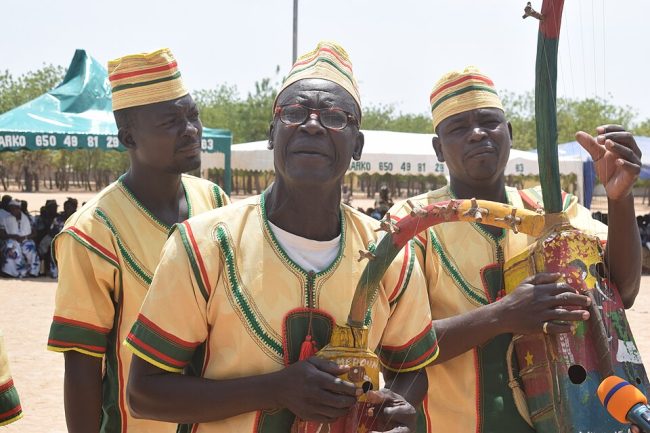
Discover Oríkì, the Yoruba art of praise singing that greets your spirit by name — and explore how Africa’s cultures have kept this powerful tradition alive for centuries.
Afrobeats’ colossal star Burna Boy made history as the first African artist to perform at the Grammys on February 4, 2024. His unforgettable entrance was heralded by drummers beating his oriki on the talking drums at the landmark moment, accompanied by dancers. Taking over the Crypto dot com arena at the 66th Annual Grammy Awards, he performed his Afrobeats hit “On Form” against a backdrop inspired by the streets of Lagos.
Opening on a global stage of that magnitude with traditional drummers in ceremonial dress was not an accident. It was a deliberate, very public statement. Burna Boy was essentially saying “This is where I come from, and I’m bringing it with me. This is who I am and you better recognize“. The drummers weren’t background décor. They were musical praise singers heralding the identity of a proud African son to the world.
Back in western Nigeria, someone is crying. A baby, inconsolable. The mother does not reach for a lullaby. Instead, she leans in close and begins to chant. She speaks of warriors, of lineage, of destiny. She calls the child by names older than memory. And the baby quiets.
This is Oríkì.
It is one of the oldest, most alive cultural practices in the world — and it is still happening today in homes, palaces, and city squares across Africa.
What Is Oríkì?
Oríkì (pronounced oh-REE-kee) is the oral praise poetry of the Yorùbá people of southwestern Nigeria. The word combines orí (meaning “head”, or spiritual identity, destiny or consciousness) and kì (meaning “to greet” or “to praise.”) Together, they form a profound act: the praising of a person’s spiritual essence.
In Yorùbá cosmology, the head is the seat of destiny. So when you chant someone’s Oríkì, you are not merely complimenting them. You are speaking directly to their soul. You are invoking who they are — and who they are called to become.
Oríkì is more than poetry. It is a spiritual salute. A passport of identity. A living archive.
The Many Forms of Oríkì
Oríkì is remarkably versatile. It exists in several categories:
Oríkì Ìdílé is family or lineage praise. It traces a person’s ancestry and recounts the deeds of their forebears. When you hear this chanted at a wedding or ceremony, you are hearing centuries of oral history condensed into rhythm.
Oríkì Ṣókí are short personal praise names tied to the circumstances of a child’s birth. A boy born with the umbilical cord around his neck, for instance, is named Òjó — and his praise name carries a coded meaning: that he would be a darling to women, though a little impatient. Nothing is random. Everything speaks.
Oríkì Òrìṣà are chants dedicated to Yorùbá deities — Ògún, Ṣàngó, Ọ̀ṣun — invoking their power and character. Interestingly, today many Nigerian Christians and Muslims also use the structure of Oríkì to praise the God of gods.
Oríkì Ọba are royal praise poems, delivered at the king’s court by palace drummers playing the gángan — the famous Yorùbá talking drum whose tonal patterns mirror the rhythms of the language itself.
And yes, the Yorùbá have Oríkì for animals, towns, rivers, foods, and even everyday objects. As scholar Vidal noted, the Yorùbá have praise poetry for “almost everything.”
Why Parents Praise-Sing Their Children
Here is where Oríkì becomes something rare and beautiful.
In Yorùbáland, parents actively use praise singing to raise their children. When a child misbehaves, a parent does not only scold — they chant the child’s Oríkì. When a child succeeds, the Oríkì rises like a victory anthem. When a child needs courage, the recitation of their lineage reminds them of the blood running through their veins.
As Yorùbá historian Samuel Johnson observed, Oríkì is intended to have a stimulating effect on its bearer. For boys, the names tend to evoke heroic, brave, or strong qualities. For girls, they carry endearment, tenderness, and value. Think of names like Àjàmú — “one that we fight to take possession of” — or Àníké — “one we cherish and pamper.”
The effect is psychological genius. You are not just telling a child who they are. You are telling them who they have always been. And children rise to meet it.
The Specialists: Akẹ́wì and the Talking Drum
In formal settings, Oríkì is delivered by an Akẹ́wì — a trained praise singer who serves rulers, elite families, and communities. The Akẹ́wì works alongside the gángan drummer, whose instrument physically echoes the words being chanted.
Different vocal styles exist for different contexts. The ìjálá style is acoustically open and intense, traditionally used by hunters. The ewì style is performed in a high falsetto — almost wailing — used for more elevated poetic recitations.
The performance is not passive. It is theatrical, rhythmic, and alive. And it carries weight. As scholar Waterman wrote, “The words that placate gods and drive kings to suicide are made more potent by the patterning of timbre, texture, pitch, and rhythm.”
That is the power sitting inside a praise chant.
Oríkì Across Africa: The Tradition Has Many Names
Oríkì is not unique to the Yorùbá. Across Sub-Saharan Africa, cultures have independently developed nearly identical traditions — all rooted in the same truth: that spoken words, rhythm, and lineage can unlock a human being’s deepest potential.
Izibongo — The Zulu and Xhosa of South Africa
In South Africa, the Zulu and Xhosa peoples practice Izibongo. The praise poet, called an Imbongi, recites at weddings, funerals, royal coronations, and political rallies.
Two Imbongi stood at Nelson Mandela’s presidential inauguration in 1994, chanting his praises before the nation. That moment said everything about how seriously Southern Africans take this tradition.
Izibongo is not purely flattering, either. It has a sharp political edge. Under the principle of “poetic licence,” the Imbongi is permitted to publicly criticize the king or leader — embedded within the praise. The tradition mediates between the power of rulers and the voice of the people. It is protest poetry dressed as praise.
A Zulu clan praise traces lineage back to a founding ancestor. If your surname is Mandela, your Izibongo invokes ancestral names — Madiba, Sopitsho, Ngubengcuka — connecting you to a line of identity stretching back generations.
Jaliyaa — The Griot Tradition of the Mandinka
Across Mali, Senegal, The Gambia, and Guinea, the Mandinka and Mandé peoples rely on the Jali (also spelled Jeli or Griot) for praise singing. Unlike Oríkì, which any parent can chant, the Jali tradition is a hereditary profession — passed from parent to child across centuries.
The Jali performs with the Kora, a 21-string West African harp, or the Ngoni, a plucked lute. Each noble family has a specific melody — a Donkili — tied to their surname. Hear the opening notes of a Keita family song, and every Keita in the room will feel it in their chest.
The Jali does not just praise individuals. They carry the history of entire empires (the Mali Empire, the Songhai) and connect modern people to the greatness of their collective past.
Apae and Mmrane — The Akan of Ghana
The Akan people, including the Ashanti and Fante of Ghana, have a two-part praise system. Mmrane are descriptive praise titles given to individuals based on character, birth, or achievement. A brave war leader might earn the title Osahene — war captain.
Apae is higher-level court praise poetry, recited at royal festivals like the Akwasidae by court criers called Asenfo. It celebrates the military victories, mercy, and supreme authority of the Asantehene — the king. It is performed to the thunder of the Fontomfrom, Ghana’s royal drums.
Gabay — The Somali Tradition
Somalia is often called a “nation of poets,” and rightly so. The Gabay — Somalia’s praise poetry tradition — carries enormous political and social power. A finely crafted praise poem can elevate a clan’s status across an entire region. A satirical one can damage a family’s reputation for generations.
Somali praise poetry focuses on collective honor, bravery, and ancestral territory. It is competitive in the best possible way — a battle of words, wit, and memory.
Comparison at a Glance
| Culture | Tradition | Performed By | Accompaniment |
|---|---|---|---|
| Yorùbá | Oríkì | Parents, Akẹ́wì | Gángan (Talking Drum) |
| Zulu / Xhosa | Izibongo | Imbongi | Vocal rhythm, foot stomping |
| Mandinka | Jaliyaa | Jali (Hereditary Griot) | Kora or Ngoni |
| Akan | Apae / Mmrane | Court poets, Elders | Fontomfrom (Royal Drums) |
| Somali | Gabay | Community poets | Voice |
The Tradition Today: Alive, Adapting, Under Pressure
Oríkì is thriving — but it is also fighting.
On the positive side, the tradition is adapting brilliantly. Nigerian politicians hire praise singers to connect with voters through lineage chants. A modern performance art called hype performance — where entertainers energize crowds with Oríkì-inspired chants — has gone viral across social media platforms. Nollywood films now use Oríkì as a narrative device, reaching younger audiences who might never have sat in a village square.
Nigerian-American author Luvvie Ajayi Jones brought Oríkì to global audiences through her book Professional Troublemaker, where she describes it as “a Yoruba greeting that praises you through your kinship and speaks life to your destiny.” She launched an Oríkì challenge online, inspiring thousands of people worldwide to write their own.
Social media has sparked a genuine resurgence. Young urban Yorùbá people are filming family elders reciting ancestral Oríkì. Cultural organizations are archiving praise poetry before it is lost. Families separated by migration are reconnecting through shared lineage chants on Zoom calls.
But the threats are real. Westernization, the influence of English, and shifting religious attitudes have eroded the tradition in many homes. Many young Yorùbá people have anglicized their names and no longer know their family Oríkì. As one writer noted, this is not just the loss of words — it is the weakening of communal bonds that Oríkì helped hold together.
The same pressure applies across the continent. In South Africa, fewer young people enter the profession of Imbongi. In West Africa, Jali families face economic pressures that commercialize what was once sacred knowledge.
Yet the tradition persists. Because the need it serves (to be seen, named, celebrated, and connected to something larger than yourself) is a human need that never goes away.
The Deeper Truth
Every culture on earth has found a way to answer the same question: Who are you, and why does it matter?
In Yorùbáland, the answer has always been chanted, not written. It lives in the throat of a grandmother, in the taut skin of a talking drum, in the rhythm of names older than any living person can remember.
Oríkì says: You are not just yourself. You are everyone who came before you. And when I call your name, I call all of them too.
That is not just poetry. That is identity.
If you have a cultural heritage that practices praise singing, ask an elder about your Oríkì. If you do not know it yet, it is never too late to find it. Your ancestors have been waiting to be called.
#Oriki #YorubaHeritage #AfricanCulture #PraiseSinging #Feelnubia #AfricanOralTradition #Izibongo #Griots #AfricanIdentity #Yoruba #BlackCulture #CulturalHeritage #AfricanHistory #OralPoetry #WestAfrica

