
Queens and Mothers: Pokou’s Crushing Sacrifice To Build a Nation
 FN Educational Resources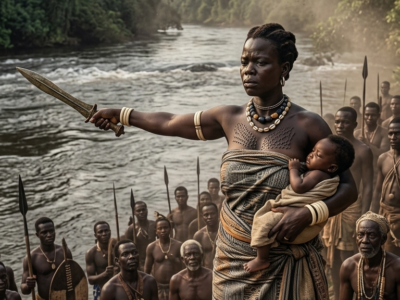
The choices before Queen Pokou at Comoé River were excruciating (Imagined by Gemini)
A queen stood at the edge of a swollen river. Enemies closed in behind her. Her people had nowhere left to run. What she did next gave an entire nation its name. Her name was Pokou, also called Awura, Aura, or Abla Pokou. She founded the Baoulé people of modern Côte d’Ivoire, and her story still shapes Ivorian identity today.
A Princess Born Into Power
Pokou was born around the early 1700s in Kumasi, in what is now Ghana. She grew up as a princess of the Ashanti Empire, one of the most powerful states in West Africa. Her uncle was Osei Kofi Tutu I, the king who co-founded the Ashanti state.
Ashanti succession ran through the female line. A king’s heir came from his sister’s or niece’s bloodline, not his own children. That system put Pokou close to real power. Her identity as a royal woman was not a side note. It was the whole point.
A Kingdom Torn Apart
Trouble followed Osei Tutu’s death. Ashanti succession battles turned violent. Pokou’s brother Dakon held a claim to the throne, and he died in the fighting that followed. Historical accounts differ on the exact timeline and rivals involved, since Ashanti history in this period rests heavily on oral tradition. What stayed consistent across every version: Pokou’s faction lost, and she knew what came next.
Execution. Enslavement. Or exile. Pokou chose exile. She gathered loyal court members, warriors, and ordinary families, and she led them west, away from Kumasi, away from the empire that had raised her.
The River That Demanded a Price
The exodus pushed toward the Comoé River, near today’s border between Ghana and Côte d’Ivoire. Enemy soldiers followed close behind. The river itself blocked their path, swollen and impossible to cross.
Oral tradition says Pokou turned to her court priest. She asked how her people could survive the crossing. The answer came back brutal: the river demanded a sacrifice, and only a royal child would satisfy it.
Pokou tried everything else first. She offered cattle. She offered gold. The river took neither. Faced with her people’s survival against her own son’s life, she made the hardest choice a mother can make. She threw her infant son into the water.
Legend says the river calmed the instant the sacrifice was made. Some versions describe hippopotamuses rising to form a path across the water. Others describe massive trees bending low, creating a bridge for the people to cross. Every version ends the same way: the people crossed, and Pokou’s son did not survive the journey.
Once safely on the far bank, Pokou turned back toward the river. She wept and cried out, “Ba ouli.” The words mean “the child is dead.” Her people took those words and made them their name: Baoulé.
Building a Kingdom From Nothing
Pokou led her followers into the fertile savanna between the Comoé and Bandama rivers, in what is now central Côte d’Ivoire. There, she built more than a refuge. She built a kingdom.
Under her leadership, the Baoulé grew into farmers and traders. Records describe her as a ruler who valued diplomacy over conquest, defending her people rather than attacking others for territory or plunder. That approach shaped Baoulé identity from the very start: practical, agricultural, and rooted in community rather than expansion for its own sake.
Pokou died around 1760. Since her only son had died in the river crossing, the throne passed to her niece, Akwa Boni. Akwa Boni proved to be an expansionist ruler, pushing Baoulé territory further and crossing the Bandama River to claim new land. The kingdom Pokou founded did not stay small for long.
A Legacy That Still Lives Today
The Baoulé people remain one of the largest ethnic groups in Côte d’Ivoire today, making up roughly 15 percent of the national population. Their roots trace directly back to Pokou’s exodus and her devastating choice at the river’s edge.
Pokou’s story carries weight far beyond a single ethnic group’s origin myth. Across West Africa, she stands as a symbol of sacrifice, of maternal strength pushed to its most extreme limit, and of leadership that puts a whole community’s survival above personal loss. Few founding stories anywhere carry that same emotional and moral weight.
Her legend has crossed into modern art and literature too. Ivorian author Véronique Tadjo reimagined the story in her novel Queen Pokou: Concerto for a Sacrifice, offering multiple versions of the legend and exploring what Pokou’s choice really meant. The story also reached the screen in the animated film Pokou, Princesse Ashanti, introducing her legend to new generations who might never encounter oral history firsthand.
The Morale of Her Story
Historians note that Pokou’s tale blends real events with the shape and symbolism of oral tradition, the way most founding legends do across cultures and centuries. The broad strokes hold up well: a real succession crisis in the Ashanti Empire, a real migration west, a real kingdom built by refugees who had nowhere else to go. The specific details of the river crossing carry the weight of legend, passed down and shaped by generations of storytellers.
That blend of history and legend is exactly why Pokou’s story endures. It gives the Baoulé people something concrete: a real place, a real river, a real migration route still traceable on a map. And it gives them something larger than history alone can offer: a founding story about what a leader will sacrifice to save the people who trust her.
Stand on the banks of the Comoé River today, and you stand where a queen once made an impossible choice. That choice created a name, a people, and a kingdom that still thrives centuries later.
Note on the record: much of Queen Pokou’s story survives through oral tradition rather than written record, so exact dates, family relationships, and details of the river crossing vary between accounts and remain difficult to verify with certainty. The account above reflects the versions most widely documented by historians and cultural sources.
