
Jewel of the Planet: Why Africa Keeps Being Redrawn by Outsiders
 Ibironke Babalola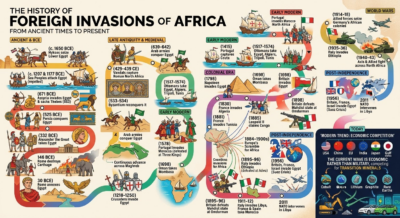
Timeline of Africa’s Foreign Invasion (Imagined by LML)
From the Hyksos (through Berlin), to the coming rare-earth economy, one continent has been the object of external ambition more consistently than any other, for far longer than most accounts admit. The reasons are structural, not accidental.
Seeing the pattern
Call it the Recurring Partition: a sequence stretching back more than 3,600 years in which outside powers have repeatedly asserted control over African territory or resources. The cast changes (Levantine, Assyrian, Persian, Greek, Roman, Vandal, Byzantine, Arab, Ottoman, Omani, European, and now a wider field of global actors), and each wave is justified by a different logic. The underlying shape stays the same: conquest or leverage first, extraction second, and a local population whose consent was never structurally required.
The record begins around 1650 BCE, when the Hyksos seized Lower Egypt. Assyria followed in 671 BCE, sacking Thebes a few years later. Persia conquered Egypt in 525 BCE, Alexander the Great in 332 BCE, and Rome destroyed Carthage in 146 BCE before annexing Egypt in 30 BCE. Vandals and Byzantines fought over Roman North Africa in the 5th and 6th centuries CE, and Arab armies swept across Egypt and the Maghreb in the 7th. Crusaders landed in Egypt in the 13th century, Portugal took Ceuta in 1415, the Ottomans absorbed the northern coast in the 16th century, and Oman built a dominion along the eastern coast from the late 1600s. Then came Napoleon, the French invasion of Algeria, the British occupation of Egypt, and the Scramble for Africa, followed by the Italian invasion of Ethiopia, the world wars, Suez, and the 2011 intervention in Libya.
What distinguishes Africa isn’t that it suffered more than every other colonized region. The Americas and Australia arguably experienced something more total, with near-total demographic collapse under fewer external hands. What distinguishes Africa is the variety and continuity of the outside actors involved. Few other continents have been approached by so many distinct external civilizations, from so many directions, across such an unbroken timeline. The “Recurring” in Recurring Partition is literal: the 1880s Scramble was the most compressed and systematic wave, but it was neither the first nor an aberration.
The well that never runs dry
Geography made Africa reachable from every direction. Egypt sits at the land bridge between Africa and Asia, and the Mediterranean made the northern coast a natural target for every power that ruled its shores. The Red Sea and Sahara brought Arabia close, and open coastlines on both the Atlantic and Indian Oceans meant no single set of outsiders ever held exclusive access. The Americas and Australia, by contrast, were isolated from Old World contact until one decisive encounter.
Political fragmentation lowered the cost of piecemeal conquest. Numerous regionally organized polities, rather than a small number of unified empires, made sequential external control more tractable over millennia. The major exceptions, such as Egypt, Carthage, and later Ethiopia, drew some of history’s largest invasion forces.
Disease delayed, then compressed, colonization of the interior. Malaria kept most 19th-century Europeans confined to African coastlines while they colonized the interior of the Americas almost immediately. When quinine and industrial weaponry removed that barrier, decades of restraint collapsed into the brutal compression of the Scramble.
Running beneath all three is the one constant that turned opportunity into action: resources.
Egypt’s grain made it a prize for Rome, and Carthage’s agricultural wealth and trade made it a rival worth destroying. North Africa became a granary of the Roman world. Gold, ivory, and captive people drew the interest of Arab, Portuguese, and Omani powers across the medieval and early modern centuries. Industrial-era colonization was explicitly organized around rubber, cotton, palm oil, and minerals, and Leopold’s Congo Free State is the starkest case, an entire regime built on forced rubber extraction. The Cold War brought uranium and cobalt into strategic calculus, tying superpower intervention to mineral geography. Strategic position mattered too, as the Suez Canal shows, but resources and routes together explain more than any single motive. Resources don’t just explain how conquest was possible, they explain why it was worth the cost, in every era.
Projections: the next scramble is already visible
The pattern hasn’t stopped, only changed its nomenclature. Africa holds an outsized share of what the clean-energy and technology transition requires (cobalt, manganese, platinum, lithium, copper, graphite), and demand is accelerating faster than in most commodity cycles in decades. The competitors are the familiar cast in new form: the United States and China leading, with the EU, Japan, India, and the Gulf states pressing in behind. Each is racing to lock in supply through investment, offtake deals, and strategic partnerships rather than through flags and treaties.
Three plausible trajectories are visible at once, and different African states are likely to land on different ones:
- Negotiated leverage: states like the DRC using export quotas, beneficiation requirements, and multiple competing suitors to extract better terms than colonial-era extraction ever allowed.
- Elite capture: resource wealth enriching narrow governing circles while broader populations see little benefit, replicating the “resource curse” dynamic seen in oil-rich states for decades.
- Renewed external dictation: weaker or less-organized states effectively ceding decision-making power to whichever outside patron offers the most attractive financing, with terms set far from the negotiating table.
What’s different this time, and genuinely uncertain in its effect, is that African governments are internationally recognized sovereign parties rather than absent from the room. The field of competing outside powers is also fragmented enough that playing them against each other is a live strategy rather than a hypothetical one.
What a different outcome would require
If the resource factor is the constant that has driven every previous wave of external control, breaking the pattern means changing who captures the value of the resources themselves, not just who extracts them. A few levers stand out as the most consequential.
Collective bargaining over fragmented negotiation. A single African country negotiating alone has far less leverage than a bloc negotiating together. The African Continental Free Trade Area and coordinated mineral-policy platforms are early, imperfect steps in this direction. The goal is a common floor on royalties, transparency, and local content that no single investor can undercut by moving to the next capital.
Beneficiation over raw export. Nearly every extraction wave shipped raw material out and finished value in elsewhere, from Roman grain to colonial rubber. Requiring in-country processing and refining before export is the single biggest lever for capturing more of the value chain domestically.
Revenue transparency and anti-capture institutions. Resource nationalism without accountable institutions tends to produce elite capture rather than broad development. Publishing contract terms, auditing mining revenue independently, and insulating the management of mineral wealth from political patronage are unglamorous but decisive.
Diversifying patrons deliberately. Today’s multipolar competition is a structural opportunity that didn’t exist in 1884 or even 1960. No single power can dictate terms when others are bidding for the same access. States that actively cultivate multiple serious suitors, rather than defaulting to whichever partner arrived first, preserve far more negotiating room.
Investing extraction revenue outside the extraction sector. Every commodity boom on this continent has been followed by a bust. Sovereign wealth funds and mandated reinvestment into infrastructure, education, and non-mineral industry are what convert a finite mineral advantage into a durable one.
None of this guarantees a different outcome. The Recurring Partition has survived more than three millennia of shifting justifications precisely because the underlying incentive (valuable resources, external demand, and asymmetric leverage) hasn’t gone away. But for the first time, the party with something to negotiate over is sitting at its own table, in a field crowded enough with competing bidders that the terms are no longer purely dictated in a room a continent away.
This piece synthesizes historical record, current reporting on the global critical-minerals competition, and reasoned projection. The forward-looking sections reflect informed analysis rather than certainty, and outcomes will likely vary significantly by country.
Recommended
Africa as the Last Reserve of Human Fertility
