
Portal to Atlantis or Geological Marvel: The Eye of the Sahara
 Ibironke Babalola
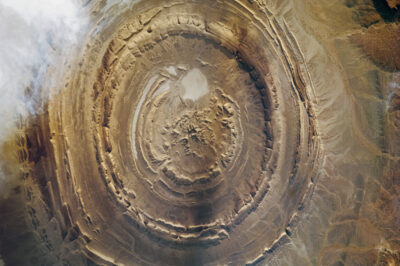
Eye of the Sahara (Richat Structure) as seen from Space (Image: Wikimedia/NASA)
Africa is a continent of unparalleled biodiversity, rich culture, and deep, enduring mystery. For centuries, its most stunning natural landmarks have inspired myths, legends, and a sense of the supernatural. From massive formations visible from space to water that flashes with spectral light, the continent holds secrets that science is finally unlocking. Come with us on a journey to explore the true stories behind some of the most captivating African mysterious phenomena; and learn how you can witness them yourself.
The Eye of the Sahara: Portal to Atlantis or Geological Marvel?
The Discovery
Hidden deep within the Mauritanian sands of the Sahara Desert lies the Richat Structure, more famously known as the Eye of the Sahara or the Eye of Africa. This colossal, circular formation, spanning over 25 miles (40 kilometers) in diameter, is so distinctive it has been used as a landmark by astronauts since the Gemini missions in the 1960s. From space, it appears as if a giant eye is staring back at the cosmos; a perfect bull’s-eye etched into the desert.
The Myths & Legends
The structure’s perfect concentric circles immediately fueled one of the greatest modern myths: that it is the remains of the lost city of Atlantis described by Plato around 360 BCE. In his dialogues “Timaeus” and “Critias,” Plato described Atlantis as a powerful island nation with a capital city arranged in concentric rings of water and land; eerily similar to the Richat Structure’s appearance.
Proponents of the Atlantis theory point to:
- The exact circular shape matching Plato’s description
- Its massive scale (Plato described Atlantis as “larger than Libya and Asia combined”)
- Its location in what was once a wetter, more habitable region
- The presence of ancient tool fragments found in the area
Local Berber tribes have their own legends, believing the structure to be the dwelling place of djinn (spirits) or a cursed land where ancient kings once ruled. Some say the circles mark the foundation of a city built by beings from the sky.
The Science
Despite its alien, manufactured appearance, the Richat Structure is entirely terrestrial; a masterpiece of geological forces. It is not an impact crater, as initially suspected, but a deeply eroded geological dome created through a process called differential erosion.
How it formed:
Geologists theorize that the structure formed approximately 100 million years ago during the Cretaceous period when molten rock (magma) surged beneath the Earth’s crust, uplifting the overlying sedimentary layers into a massive dome. This created alternating rings of different rock types: harder quartzite layers and softer sandstone layers, along with volcanic intrusions.
Over millions of years, erosion by wind and water wore away these different rock types at varying speeds. The softer sandstone eroded faster, creating valleys, while the harder quartzite layers remained elevated, forming ridges. This differential erosion sculpted the spectacular concentric rings we see today; a rare and powerful demonstration of Earth’s slow, persistent geological processes.
The structure consists of:
- Outer rings: Predominantly sedimentary rocks (sandstone and limestone)
- Inner core: Igneous rocks (rhyolite and gabbro) from volcanic activity
- Intermediate rings: Mixed sedimentary and volcanic rocks
How to Visit the Eye of the Sahara
Location: Near Ouadane, Mauritania, in the Adrar Plateau region
Best Time to Visit: November to February (cooler temperatures, 20-25°C/68-77°F during the day)
Getting There:
- Fly to Nouakchott, Mauritania’s capital
- Take a domestic flight or drive (approximately 450km/280 miles) to Atar, the nearest major town
- Hire a 4×4 vehicle with experienced driver/guide (essential – the desert is unforgiving)
- Journey approximately 2-3 hours from Atar to the structure
What You’ll Need
- Visa: Most nationalities require a visa for Mauritania (obtain in advance)
- Guide: Mandatory – local guides know water sources and safe routes
- Equipment: GPS, satellite phone, extensive water supplies (5 liters per person per day minimum)
- Gear: Sun protection, desert clothing, camping equipment
- 4×4 Vehicle: Sand driving experience essential or hire with driver
Tour Operators:
- Mauritania Tours – Specialized desert expeditions
- Sahara Expeditions – Multi-day tours including the Eye
- Local guides from Atar – Can be arranged through hotels
Cost: Expect $150-300 USD per day including guide, vehicle, camping, and meals
Pro Tips:
- The best views are actually from aerial perspective – consider joining a group to charter a small plane from Atar
- Camp overnight near the structure for sunrise/sunset photography
- Combine with visits to ancient trading cities like Chinguetti and Ouadane
- Download offline maps; there’s no cell service
- Respect the fragile desert ecosystem; take all trash with you
Safety Considerations:
- Travel in groups of at least 2 vehicles (desert safety protocol)
- Inform authorities of your itinerary
- Check current travel advisories (security situation varies)
- Extreme heat in summer (40-50°C/104-122°F) can be life-threatening
All travel information current as of November 2025. Always check current travel advisories, visa requirements, and safety conditions before traveling. Consult with local tour operators for up-to-date information on accessibility and regulations.
Recommended (Cluster articles in development)
Unveiling Africa’s Natural Wonders: Where Ancient Myths Meet Modern Science
Meta Description: Explore Africa’s most mysterious natural landmarks from the Eye of the Sahara to glowing oceans. Discover the myths, science, and how to visit these extraordinary sites.
