
Queens and Mothers: Njinga, the Monarch Who Outwitted Portuguese Invaders
 FN Educational Resources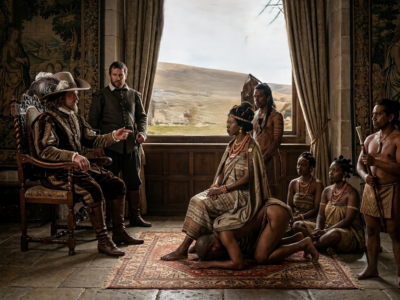
Njinga refused to play along. She sat on the back of her assistant – upright and calm, eye-level with the governor (Imagined by AI)
Queen Njinga Mbande was born around 1583 in the Mbundu kingdom of Ndongo, in present-day Angola. She grew into one of Africa’s sharpest political minds, ruling Ndongo and Matamba through decades of war. She faced down Portuguese soldiers, slave traders, and rival nobles. She never backed down.
For four decades, Njinga fought Portuguese expansion and the transatlantic slave trade. She combined battlefield skill with diplomatic genius. Few rulers, male or female, matched her staying power. She died a queen, on her own terms, at roughly 80 years old.
Here’s how she did it.
The Chair That Changed Everything
In 1622, Njinga’s brother sent her to Luanda. Her mission: negotiate peace with the Portuguese governor. It was a test. The governor set a trap. He placed one chair in the room, reserved for himself. Njinga was expected to stand, or sit on the floor, like a subject. That was the plan.
Njinga refused to play along. She signaled to one of her attendants. He dropped to his hands and knees. Njinga sat on his back, upright and calm, eye-level with the governor. The message landed instantly. She was not a subordinate. She was an equal power, and she intended to negotiate like one. The talks that followed secured a temporary peace and forced Portuguese withdrawal from key positions. It was diplomacy backed by nerve.
From Regent to Queen
Njinga’s brother died in 1624. Chaos followed. Njinga stepped in as regent, then claimed the throne outright after the rightful heir died under murky circumstances. The Portuguese saw an opening. They refused to recognize her rule. They armed a rival claimant and tried to install him as a puppet king in her place.
Njinga didn’t retreat quietly. She moved her people east. Between roughly 1631 and 1635, she conquered the neighboring kingdom of Matamba, a territory with its own tradition of female rulers. Matamba became her fortress, her recruiting ground, and her base for a war that would run for decades.
Her Military Playbook: Guerrilla Warfare and Bold Alliances
Njinga knew she could not beat Portuguese firepower in open battle. So she didn’t try. Instead, she built a guerrilla campaign designed to bleed her enemy slowly.
Her tactics were consistent and effective:
- Ambush over confrontation. Njinga’s forces struck Portuguese columns in sudden raids, then vanished before reinforcements arrived.
- Terrain as a weapon. She used Angola’s dense forests, hills, and river islands, including her stronghold on the Kindonga Islands, to escape pursuit and regroup.
- Supply-line disruption. Rather than face Portuguese garrisons head-on, her fighters cut off food, weapons, and reinforcements.
- Strategic retreat. Njinga pulled back when outmatched, then returned to reclaim ground once Portuguese attention shifted elsewhere.
It was calculated resistance, stretched across thirty years of near-constant conflict.
The Imbangala: Fierce Warriors, Fiercer Alliance
Njinga also reshaped her army by absorbing Imbangala fighters, a nomadic warrior society feared across Central Africa for their combat skill and battlefield discipline.
She sealed the alliance through marriage and ritual, then had her own Mbundu forces trained in Imbangala fighting methods. The partnership gave her seasoned troops overnight. It also gave her legitimacy among a group that respected strength over bloodline, a currency Njinga had in abundance.
The Dutch Connection
By the 1640s, Njinga found a new ally: the Dutch West India Company. The Dutch wanted the Portuguese out of Angola’s coastal trade routes. Njinga wanted the same thing. She combined Dutch troops with her own forces and pushed the Portuguese out of key coastal fortresses. It was a rare moment of leverage: a European power fighting alongside an African queen, against another European power, on her terms.
Faith as a Weapon
Njinga converted to Catholicism during the 1622 negotiations, taking the name Dona Ana de Souza. The move opened diplomatic doors with the Portuguese and gave her a shared religious language to negotiate with.
But her faith bent to strategy, not the other way around. She stepped away from Catholic practice when it suited her politics, then returned to it later when circumstances shifted again. For Njinga, religion was one more tool in a very large toolbox.
A Legacy Built to Last
Njinga ruled until her death in 1663, reportedly around age 80. That alone set her apart. Many rulers of her era died in battle or lost their thrones to rivals. Njinga did neither. Matamba stayed independent long after she was gone. Her decades of resistance slowed Portuguese expansion and disrupted the machinery of the slave trade at a critical moment in its growth.
Today, Njinga is remembered across Angola and the African diaspora as a symbol of resistance, sharp statecraft, and fearless leadership. Her story remains one of the clearest examples in history of a woman who refused every chair she wasn’t offered, and built her own throne instead.
RECOMMENDED
Read about more Queens
