
The Leopard: Sacred Symbol of Governance and Resistance
 FN Educational Resources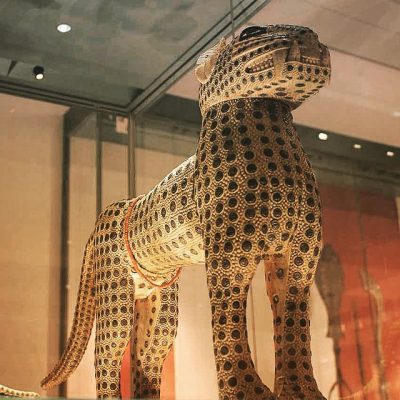
Animals are a distinct feature of the art, religion, and power of precolonial Africa, from Igbo-Ukwu’s bronzes to the Ekpe Leopard Society of the Cross River. The leopard did not just prowl Africa’s forests; it loomed large in the culture. Long before European contact, Africa’s ancient civilizations understood that perfectly. They carved its image into bronze, built secret societies in its name, and wore its skin to speak to the gods.
This is the story of the leopard—one of Africa’s most powerful spiritual symbols and its most misunderstood shield of resistance.
Forged in Bronze
Around 850 CE, master craftsmen in southeastern Nigeria were creating objects the world had never seen. At Igbo-Ukwu, center of the Kingdom of Nri, metalworkers cast bronze vessels of breathtaking precision. Tiny insects appeared to have landed on their surfaces—not added later, but cast into the original design.
The leopard lived here, too. Its image decorated ritual objects belonging to the Eze Nri, the priest-king who ruled through spiritual authority rather than standing armies. The leopard marked his power, signifying the boundary between the earthly and the divine. These bronzes predate the famous artworks of Ife and Benin, revealing trade routes stretching to Egypt and carrying the leopard’s mark across 1,000 years of history.
The Society That Wore the Leopard
The Ekpe (or Mgbe) Society changed African history. More than a “secret society,” it functioned as a legislature, a court, and an executive authority across southeastern Nigeria and southwestern Cameroon. It crossed ethnic lines—the Efik, Ejagham, Igbo, and Ibibio all operated within its reach.
Membership depended on rank within the leopard’s hierarchy. The most powerful members wore Ukara cloths: deep blue textiles blazing with sacred symbols called Nsibidi, one of Africa’s oldest indigenous writing systems. Through Ekpe lodges, knowledge flowed and justice was dispensed.
The Campaign of Extermination
When European colonizers arrived, they recognized the Ekpe not as a “club,” but as a rival government. Because the society held authority in many societies and operated in shadows, the British viewed it as the single greatest threat to their “civilizing” mission.
In the early 20th century, and peaking in the 1940s, colonial authorities launched a systematic campaign to destroy the Leopard Societies. This was a “shadow war” characterized by the “Man-Leopard” Propaganda: Colonialists rebranded these sophisticated governance groups as “cannibalistic cults.” By labeling members as “savages,” they justified legal extermination.
The British put bounties on the heads of suspected members and conducted mass public trials. In the 1940s, dozens of leaders were executed in an attempt to decapitate the society’s leadership. Recognizing that Nsibidi was a dangerous tool of secret communication, colonialists burned meeting houses (Lodge houses) and destroyed Ukara cloths. They banned the script in schools, hoping to wipe the Leopard’s language from history.
Writing in the Leopard’s Language
Nsibidi is a sophisticated system of ideograms. Scholars have found Nsibidi symbols on pottery dating to the 6th century CE, with roots reaching back to 200 CE.
Despite the colonial attempt to hunt down its practitioners, Nsibidi survived through the very secrecy the colonizers feared. While the “higher” esoteric symbols were targeted, the core of the language endured. Enslaved Africans carried these symbols across the Atlantic, where they evolved into the Abakuá traditions of Cuba and Veve symbols of Haiti. The leopard’s writing crossed oceans to ensure that the “voice of the leopard” would never be silenced.
Why the Leopard?
The leopard was the apex predator: silent, elusive, and lethal. It saw everything but revealed nothing. In West African spiritual thought, these were the qualities of divine authority and supreme perception.
The colonialists tried to hunt the Leopard Societies into extinction, but they failed. The Ekpe and Mgbe societies still exist today, having transitioned from underground resistance back into their roles as guardians of culture. The bronze vessels of Igbo-Ukwu rest in museums, and the Ikom monoliths still stand in their ancient circles. The leopard endures—not just as a relic of the past, but as a symbol of an African power that refused to be broken.
Africa’s power has always been its own.
