
The Bitter Soup: Grandma’s Kitchen as a Pharmacy
 FN Educational Resources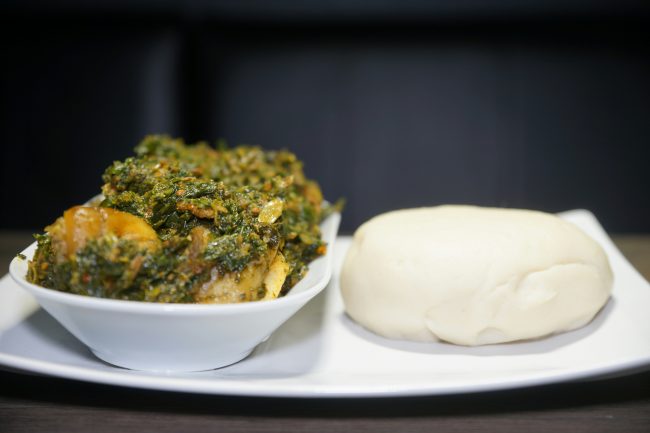
There is a taste that Yoruba people have always understood, that most of the world has spent centuries trying to breed out of existence. Bitter.
This is not the fashionable bitterness of dark chocolate or a craft beer. Something older than that. The bitter taste of ewuro (bitter leaf) that leaves a clean, almost indignant aftertaste at the back of the tongue. The dry, chalky recoil of orogbo (bitter kola), passed around at ceremonies with the gravity of a sacrament. The deep, medicinal darkness of agbo: the infusion of roots, bark and leaves that your aunt presented in a small enamel cup with an expression that made clear you were not being offered a choice.
These were foods that did not apologize for themselves. They were not trying to please you. They were trying to do something for you.
It turns out that this is among the oldest and most sophisticated nutritional philosophies in the world.
———
The Yoruba palate was not built around pleasure. Or rather — it recognized a pleasure that most modern food cultures have entirely forgotten: the pleasure of the body working properly. The satisfaction of a system in balance. The deep, whole-body rightness of food that functions.
Before colonialism imported sugar as a mass commodity, Yoruba cooking organized itself around an entirely different flavor logic. Sweetness appeared where nature put it: in ripe plantain, in sweet potato, in honey; and honey itself was primarily medicine and ritual offering, not something to pour onto everything. The dominant flavors were the deep savory taste of iru (fermented locust beans), smoked crayfish, and palm oil; and underneath everything, running through the whole food culture like a bass note: bitter. The taste of the medicinal world. The taste of something working.
The Igbo call bitter leaf onugbu, the Hausa: shiwaka. The Akan of Ghana have their own bitter greens, their own bitter seeds, their own logic. The same plant, the same taste, the same cultural philosophy independently arrived at across the whole of West Africa, as a region’s collective wisdom about what food is actually for.
Food was the first doctor. And bitterness was how you knew the medicine was real.
———
Then, it gets strange and wonderful.
Researchers studying global happiness began noticing something they could not explain. In 2003, a major international survey (assessing well-being across more than 65 countries) announced that the happiest people on earth lived in Nigeria. This baffled the economists, who measure happiness through income, life expectancy, and governance. By every such measure, the result made no sense. Nigeria should not have been happy. Nigeria was, empirically, having a very hard time.
Yet, the optimism was, as one observer put it, almost a tangible thing.
Then the finding became more targeted. Scientists studying human genetics discovered that a specific inherited variant of the fatty acid amide hydrolase (FAAH) gene (present in a substantial portion of West African populations) causes the body to produce elevated amounts of a molecule they named from the Sanskrit word ananda: bliss, happiness, delight.
This molecule governs your mood, your experience of pain, your ability to recover from fear, your resilience after loss. When it is high, you feel capable. Like the world is manageable. Like there will, in fact, be a tomorrow. Most people break it down quickly — the feeling is transient. But in people with this inherited variant, it accumulates. It lingers. The fear circuits of the brain work differently. Bad memories lose their grip more readily. The whole system is, constitutionally, more inclined toward recovery than toward rumination.
Research drawing on HapMap population genetics data suggests the FAAH A-allele (rs324420) appears in approximately 35–45% of the Yoruba population sampled in Ibadan, Nigeria — compared to roughly one in five Europeans (around 20–21%) and approximately 14–17% among East Asian populations including Han Chinese.
Researchers found a correlation between national happiness scores and the prevalence of this allele: the nations where this variant is most common also tend to report higher well-being. West Africa, and Nigeria in particular, sits near the top of both lists.
This is not coincidence either. A significant share of the Yoruba population is structurally inclined toward resilience — not performing happiness in the face of hardship, but built for it at the level of blood and inheritance.
———
Now go back to the pot.
Specifically, the amala (fermented yam or plantain meal) and ewedu pot — the combination that the people of Igbo-Ora, the Yoruba community that holds the world record for the highest twin birth rate on earth, specifically credit for their extraordinary fertility.
“We use ilasa to eat amala a lot, and twins do come each time we do that.” — community elder, Igbo-Ora
Ilasa is also known as ewedu. Jute leaf. Known as rama in Hausa, ahinghara in Igbo; yet another plant with a name in every Nigerian language, pointing to an appreciation so ancient it arrived independently across cultures.
What is in ewedu, exactly? Among other things: one of the richest natural sources of folate. Some observational research has suggested a link between higher folate intake and increased rates of dizygotic (non-identical) twinning, through an influence on ovulation. Women who eat folate-rich food consistently, across their reproductive lives, may be more likely to release more than one egg at a time.
And isu (yam), the Yoruba staple, eaten daily in various forms, across generations. Certain wild yam varieties contain phytoestrogenic compounds that have been proposed as one factor in the Yoruba twinning rate. These compounds have been described as potentially modulating the reproductive cycle, though the evidence remains observational.
Eat phytoestrogenic yam daily. Eat folate-dense ewedu regularly. Do this across generations, embedded in a body that already carries the bliss-molecule variant. And you have a population producing twins at roughly four times the global average in the specific community of Igbo-Ora — an elevation that is real and striking, whatever its precise cause.
———
But here is the part of the twin story that is almost never told: For most of Yoruba history, twins were not celebrated. They were feared.
Throughout most of ancient Yorubaland, the birth of twins was treated as an omen — a rupture in the natural order that demanded a response. That response, for centuries, was infanticide. Twins were killed. Sometimes their mothers alongside them. The very biological phenomenon that the Yoruba body was producing at higher rates than much of the world was, for long stretches of history, being answered with dread.
The orisha ibeji figures (the carved wooden twin statues that have become some of the most recognized objects in all of African art) did not begin as celebration. They began as as a coping mechanism for grief. When a twin died, a small carved figure was commissioned in their likeness. The mother carried it, fed it, dressed it, sang to it in an attempt to maintain the spiritual wholeness of a pair when the body of one was gone. Anthropologists have noted that this practice emerged from a people confronting twin births and twin deaths at rates unlike anything anywhere else on earth. The effigies were living memorials.
The switch from fear to reverence was gradual, and its timeline is debated by historians. What is clear is that by the early twentieth century the practice of twin infanticide had essentially disappeared in Yorubaland. Christianity, which arrived in force in the 1920s and 1930s, was a significant (possibly primary) driver of that shift, though an internal cultural reckoning was also underway.
But what emerged, through its own long reckoning, was something like wonder. Twins who survived were assumed to possess supernatural powers — they were not merely considered lucky, but believed to be chosen, capable of controlling fertility, prosperity, rain. They could perceive evil spirits and detect thieves. They could see what others could not.
This ambivalence of terror giving way over time to reverence is the evidence of a culture in honest negotiation with its own nature. The Yoruba body kept producing twins. The Yoruba mind kept trying to make meaning of it. And eventually, the sheer relentless biological fact won.
———
Now the question this raises is: If twins were being killed for generations (across much of Yorubaland, for much of its history) what does it tell us that the twin birth rate within this ethnic group remained among the highest on earth, regardless?
It tells us something remarkable: that the biological trait persisted across centuries of hardship and, in some periods, deliberate culling. The resilience encoded in the FAAH variant may have been doing its most important work not just in the celebration of abundance, but in the return from grief.
A people who were regularly losing children (to birth complications, to disease, to their own ancient fears) still needed the emotional architecture to survive the loss. To bury what was gone and plant something new. The bliss molecule may have been doing its most important work in that return.
———
Here then is what connects the agbo cup to the amala pot, the wood-carved orisha ibeji and to the survey finding that Nigerians report among the highest well-being in the world.
This is an inter-connected system, rather than a collection of coincidences: A genetic inheritance that keeps baseline resilience elevated and makes fear easier to release (present in a meaningful share of the Yoruba population); a food culture built around plants that do real pharmacological work on the body (bitter medicinal herbs, leafy greens dense with specific nutrients, yam compounds that may modulate the reproductive cycle); and a cosmology that slowly, painfully, transformed its own biological anomaly into sacred meaning.
These did not develop independently of each other. They grew together, across centuries, each reinforcing the others. The diet supported the gene. The gene supported the resilience. The resilience produced a culture that could sit with deep ambivalence (fear and reverence, grief and celebration) and eventually resolve it into wisdom.
The grandmother who handed you that small cup of agbo with a look that brooked no argument was not being unkind. She had inherited, and was passing on, a knowledge system developed over more generations than either of you could count. One sophisticated enough that its effects on the human body are only now becoming evident to modern science — even as the science itself remains, in places, incomplete.
The claypot was the laboratory. Bitterness was the medicine. And the people it made (resilient, fertile, physiologically inclined toward joy even in the hardest of circumstances) were the result.
Some things, it turns out, are wired into you through more sources than one.
———
Feelnubia Claypot explores the stories, science, and souls of African food cultures.
