
Africa’s Mirror: The Complicity We Overlook
 FN Policy Dialogue Series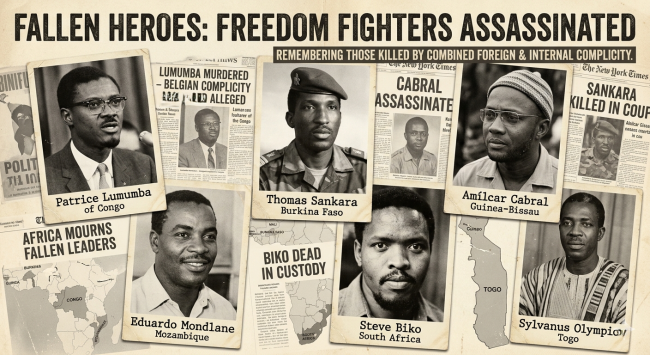
The reckoning Europe owes Africa is real. So is the reckoning Africa owes itself.
Africa demands honesty from Europe. Rightly so. But honesty is not a one-way street. The same clear eyes we turn on Paris and Brussels must turn on Abuja, Dakar, and Kinshasa. The same courage we ask of the French teacher and the Belgian nurse, we must ask of ourselves.
This reckoning is evident from African history. It is written in our own records, spoken in our own oral traditions, confirmed by our own historians. It begins with the slave trade.
African Kings Built the Slave Trade’s Engine
European ships could not penetrate the West African interior. They anchored at the coastal forts of Elmina, Cape Coast, and Gorée, and waited. It was African kings that brought the captives to them.
The Kingdom of Dahomey, in present-day Benin, did not stumble into the slave trade. It organized its entire state around it. The Agojie (the famous female warriors) conducted annual raids specifically to fill the slave pens at Ouidah. At its peak, Dahomey sold between 10,000 and 20,000 people per year to European traders. When European demand slowed, the kingdom’s treasury suffered. Dahomey was one of the trade’s primary engines.
The Ashanti Empire in modern Ghana raided neighbouring peoples and sold them through Fante intermediaries at coastal forts. The Oyo Empire in modern Nigeria used its cavalry to seize Nupe and Bariba captives and funnel them south to Atlantic ports. The Arab-Swahili networks of East Africa had been running a separate, equally vast trade across the Indian Ocean for centuries before European ships ever appeared on the West African coast.
The moral catastrophe was not distributed evenly. Some kingdoms resisted. King Afonso I of Kongo wrote to the King of Portugal in 1526, begging him to stop the trade. “We cannot reckon how great the damage is,” he wrote. Portugal ignored him. Queen Nzinga of Ndongo fought Portuguese slave-raiders for decades. The Benin Kingdom deliberately restricted coastal access to limit the trade’s reach.
These leaders faced the same choice. They chose differently. That is the point. The trade was a choice, not an inevitability. Which makes the kings who chose profit over people harder to excuse.
In 1999, Benin’s President Mathieu Kérékou stood before a congregation in Baltimore and asked forgiveness for his nation’s role. It remains one of the most remarkable acts of public accountability in African political history. No one has repeated it since.
The Man Who Invited the Bombs
Not all African complicity looks like greed. Some of it looks like faith. Some of it looks like trauma. Some of it looks, from the inside, exactly like justice.
Samuel Ajayi Crowther was twelve years old when Fulani slave raiders attacked his village of Osogun before breakfast. They seized him, his mother, his toddler brother, and his sisters. They sold them. They were sold again. Then again. By the time a British Royal Navy ship intercepted his vessel off the West African coast, Crowther had changed hands multiple times and was headed for the Americas.
The British took him to Sierra Leone. He learned English. He converted to Christianity. He studied languages with extraordinary brilliance. He was ordained in London. Oxford gave him an honorary degree. He became the first Black Anglican Bishop in the history of the church. But he never forgot what Lagos had done.
Lagos, in the 1840s, was the most active slave port on the West African coast. Oba Kosoko ran it as a commercial empire built on human cargo. African raiders brought captives from the interior. African brokers negotiated prices. African canoes moved the human merchandise to European ships waiting offshore. The trade that had destroyed Crowther’s childhood was still running; still efficient, still profitable, still entirely acceptable to those who profited from it. Crowther wanted it stopped.
On November 18, 1851, he was received at Windsor Castle by Queen Victoria and Prince Albert. The Church Missionary Society had brought him specifically to make the case for British intervention. He was their most powerful argument: a survivor, a scholar, a bishop, a living rebuke to everyone who claimed Africans could not be civilised.
When the Queen asked what could be done about the slave trade on the West African coast, Crowther did not hesitate: “Seize Lagos by fire and by force.” The British did exactly that. In November and December 1851, Royal Navy ships bombarded Lagos. Kosoko fled. The British installed Akitoye, the exiled king, who promptly signed a treaty with Britain renouncing the slave trade. Ten years later, in 1861, Britain formally annexed Lagos as a crown colony, the foundation stone of what would become Nigeria.
The slave trade at Lagos was suppressed. The British colonial project in Nigeria had begun. Crowther had asked for one. He got an unanticipated bonus.
The Three Revelations From This Story
Trauma does not confer immunity from consequence. Crowther’s motives cannot be questioned for greed or tribalism or self-interest. He had been enslaved as a child. He had watched the slave market operate with brutal efficiency. He believed, sincerely and from devastating personal experience, that British force was the only tool strong enough to stop it. He had seen Sierra Leone (educated, prosperous, freed from the trade) and believed Lagos could become the same. His suffering was real. His faith was genuine. And the outcome of his advocacy served British imperial interests more completely than it ever served the people of Lagos.
This is one of colonialism’s most cruel mechanisms. It recruits the most wounded, the most sincere, and the most morally credible as the visible face of its interventions. The person asking for the bombs is someone whose suffering cannot be questioned. The person who fires them has other plans entirely.
The converted mind is the most useful mind. Crowther’s entire worldview had been built by the people who rescued him. His language, his religion, his education, his career, his social world; all of it was constructed within the British imperial system. He did not trust that system cynically. He trusted it completely, because for him, personally, it had delivered everything: freedom, literacy, vocation, dignity. That the same system was simultaneously extracting resources across the continent, that the Church of England’s missions served as the advance scouts of commercial and military expansion. These things were invisible to him, because his frame of reference had been entirely shaped by the people he was being asked to serve.
The Church Missionary Society’s Henry Venn understood this. Bringing Crowther to Windsor Castle was described at the time as a “powerful public relations coup.” Who could argue with a formerly enslaved man who wanted only to stop slavery? Crowther was entirely sincere. He was also being used. Both things were true simultaneously.
Complicity costs the complicit. In the last decade of his life, the Church of England turned on Crowther. Younger European missionaries questioned his theology, his authority, his management of the Niger Mission. In 1890, a church tribunal stripped him of effective control of the mission he had spent his life building. He died in Lagos in December 1891, in the city whose bombing he had recommended forty years earlier. The system used him as a symbol when it needed African moral cover for an annexation. It discarded him when the annexation was complete. He received a bishop’s title, an honorary degree, and a humiliating forced retirement.
This, too, is part of the story.
Africa’s Best Leaders Were Killed by African Hands
The names are well known. Lumumba. Sankara. Cabral. Machel. Moumié. The foreign fingerprints are documented. CIA cables. Belgian intelligence memos. French SDECE operations. Portuguese PIDE infiltration networks. What gets less scrutiny is the African fingerprint beside every foreign one.
Lumumba: Betrayed from Within
Patrice Lumumba was Congo’s first democratically elected prime minister. He lasted 67 days. Belgium and the United States wanted him gone. That much is confirmed by a Belgian parliamentary inquiry, by declassified CIA cables, and by the recorded testimony of participants. But Belgium and the US could not remove Lumumba alone. They needed African partners.
President Kasavubu (Lumumba’s own constitutional colleague) dismissed him illegally in September 1960. Colonel Mobutu, his own army chief, staged the coup that placed him in captivity. Moïse Tshombe, the secessionist leader of Katanga, ordered and oversaw his execution on January 17, 1961. Belgium apologised in 2002. No Congolese official ever has.
Sankara: Killed by His Best Friend
Thomas Sankara was the most extraordinary African leader of the 20th century. In four years as president of Burkina Faso, he cancelled IMF debt, vaccinated two and a half million children in one week, planted ten million trees, banned female genital mutilation, and reduced the president’s salary to that of a schoolteacher. He refused a presidential limousine. He refused air conditioning. He said a leader who cannot live like his people should not lead his people.
On October 15, 1987, he was killed by a coup led by Blaise Compaoré: his best friend since military school, his co-conspirator in the 1983 revolution, his second-in-command.
French intelligence knew the plot was coming. It is believed that the coup was orchestrated by France. A wealth-disavowing revolutionary leader is dangerous and unpredictable as a pawn. The order to fire was given by an African man, in an African capital, for reasons of personal ambition and material gain, but was there a snake in Paradise, slithering and whispering the ideas that led to the coup? Your guess is as good as mine. Compaoré ruled Burkina Faso as a French stooge for 27 years after murdering his brother. He lives today in comfortable exile in Côte d’Ivoire, protected by a French passport.
Cabral: Cut Down Before the Finish Line
Amilcar Cabral was months away from independence for Guinea-Bissau when his own guerrillas killed him in January 1973. Portugal’s secret police had cultivated the dissidents, exploiting jealousies and ethnic tensions within the movement. But the trigger was pulled by African hands.
Cabral had said: “Hide nothing from the masses of our people. Tell no lies. Expose lies whenever they are told.” He was killed before he could build the country that motto deserved.
The pattern is consistent across every case. A foreign power identifies an internal fracture. It exploits it. It provides resources and protection to the disaffected. Then African actors do the work. The foreign power gets the outcome. The African traitor gets a measure of power, for a while. The people get nothing.
The Looting That Needs No Foreign Visa
Modern African exploitation does not require colonialism in its classical form. It requires something subtler: African governments that manage their own dispossession.
The CFA Franc: A Choice, Not Just an Imposition
The CFA franc is a French colonial instrument. That criticism is correct and important. Fourteen African nations still operate within a monetary architecture designed in Paris in 1945. That is a scandal. But here is what the full story requires us to say: African heads of state have chosen to maintain it at every critical juncture since independence.
When Guinea’s Sékou Touré rejected the CFA in 1958, France sabotaged his economy within months; withdrawing technicians, destroying infrastructure, even removing light bulbs from government buildings. That coercion was real. No one should minimize it.
But every subsequent leader who kept the CFA (in Senegal, Côte d’Ivoire, Cameroon, Gabon) made a calculation. Personal economic stability and French military protection mattered more to them than monetary sovereignty for their people. The Ivorian elite in particular built their fortunes within the CFA architecture and treated it as a feature, not a bug.
In 2019, a reform was announced. It should have ended French Treasury control. African finance ministers lobbied to dilute it. The “Eco” currency, years later, remains unrealized. This is a choice African governments keep making.
Nigeria’s Oil: Stolen by Nigerian Hands
Nigeria loses an estimated $3 to $4 billion every year to oil theft and pipeline bunkering. This is not primarily a foreign operation. It requires Nigerian military officers to provide protection. It requires NNPC officials to falsify production records. It requires state politicians to look away for a fee. It requires community leaders to charge protection money on stolen pipelines crossing their land.
The companies that refine and sell stolen crude are often registered in the UAE, Malta, and Singapore. But the taps are drilled in the Niger Delta. The protection is provided by Nigerian uniforms. The profits are shared among Nigerian elites before any dollar reaches a foreign account.
Shell and Chevron bear legal and moral responsibility for environmental destruction. The theft network is a Nigerian political economy.
$88 Billion a Year, Leaving the Continent
The Global Financial Integrity project estimates Africa loses $88.6 billion annually through illicit financial flows. Every cent of that money requires an African architect somewhere in the chain. The finance minister who approves a mining royalty set at a fraction of fair market value. The customs official who certifies a falsified export invoice. The president whose family company holds beneficial ownership of the Swiss account receiving kickbacks from a foreign infrastructure firm.
The receiving end (in London, Dubai, Geneva, Singapore) is complicit. Yes. But so is the African official who originated the transaction. Both facts are true. Calling out only one of them is sentimentality.
What Accountability Looks Like
The reckoning runs through every era and every kind of African actor. The Dahomey kings chose profit. Compaoré chose power. The CFA finance ministers chose personal stability. The Nigerian general chose a percentage of stolen crude. Each choice was different. Each outcome served someone else’s interests over Africa’s.
And then there is Crowther, who chose from faith and from grief, who wanted nothing for himself, who asked for the bombs because he had been on the other side of the trade and could not bear that it continued. He was the most morally candid of all the figures in this article. He was also instrumentalized more completely than any of them. His suffering gave the annexation a human face. His sincerity made the imperial project legible as humanitarian intervention. His advocacy cost him, ultimately, everything including the mission he had devoted his life to building.
These are not the same story. But they are all the same lesson.
When the tools you reach for belong to the people exploiting you, the outcome serves them — regardless of your intentions, regardless of your suffering, regardless of the purity of your motives. The Dahomey king knew what he was doing. Crowther did not. The result, for the people of Lagos, was structurally similar. While we ask Europeans to feel responsible, not merely guilty, the same distinction applies here.
Responsibility means seeing all of this clearly. The kings who sold their neighbours. The officers who shot their presidents. The ministers who signed the bad contracts. The bishop who, from the deepest moral sincerity, handed a colonial power its justification. We hold a mirror up to Europe because they can handle the truth.
Now we must hold one up to ourselves, including the most painful parts, especially the parts where we were trying to do good.
#AfricanHistory #AjayiCrowther #SlaveTradeHistory #Decolonisation #ThomasSankara #PatriceLumumba #AfricanLeadership #CFAFranc #Neocolonialism #AfricanAccountability #BlackHistory #NigerianHistory #Feelnubia #PanAfricanism #ColonialLegacy #AntiCorruption #AfricaDebt #BombingOfLagos #Africa2026
Recommended:
