
Empire: Kanem-Bornu, Africa’s Thousand-Year Dynasty
 FN Educational Resources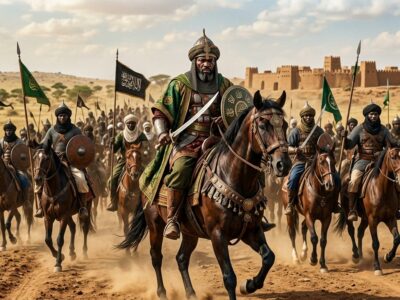
In 1808, Usman dan Fodio’s Sokoto jihad turned east toward Bornu. captured and sacked the capital, sending the reigning Mai into exile (Imagined by AI)
For over a millennium, a single royal house governed a state on the shores of Lake Chad, outlasting the Byzantine Empire, the Mongol conquests, and the entire European Middle Ages. The Kanem-Bornu Empire (and the Sayfawa dynasty that ruled most of it) is one of the longest continuous political traditions in world history, and one of the least discussed outside specialist circles. This is its story, told through the kings who built it, defended it, and ultimately lost it.
A State Born of the Sahel
Kanem-Bornu emerged in the 8th or 9th century AD, northeast of Lake Chad, in what is now Chad. It was founded not by a single conquering figure but by a confederation of nomadic Kanembu and Zaghawa pastoralists; cattle- and horse-herding peoples who controlled the Sahelian corridor connecting the Sahara to the savanna. From their capital at Njimi, the earliest rulers, known by the title Mai, governed under what historians call the Duguwa dynasty.
Two things gave this state staying power that most of its contemporaries lacked: control of the trans-Saharan trade, and, from the 11th century onward, Islam.
Conversion and the Rise of the Sayfawa Dynasty
Kanem’s ruling court adopted Islam in stages. An earlier Duguwa mai named Hu is credited as the first Muslim ruler, but it was Mai Humai (Hummay) ibn Salamna, reigning roughly 1085–1097, who is remembered as the founder of a new royal line: the Sayfawa (or Sefuwa) dynasty. The name traces a legendary (likely invented) genealogy back to a 6th-century Yemeni prince, Sayf ibn Dhi Yazan; a common move by newly Islamized African courts seeking prestige within the wider Muslim world.
The conversion mattered strategically as much as spiritually. It plugged Kanem directly into trans-Saharan networks of trade, scholarship, and diplomacy stretching to Cairo, Tripoli, and Mecca. The Sayfawa dynasty that Humai founded would go on to rule for roughly 771 years (until 1846) making it one of the longest-reigning royal houses ever recorded anywhere in the world.
Dunama Dibbalemi and the First Golden Age
The dynasty’s first great expansionist was Mai Dunama II Dibbalemi, who reigned 1221–1259. Described in the royal chronicle, the Girgam, as “a warrior hotter than fire,” Dibbalemi declared jihad against Kanem’s non-Muslim neighbors and built an army that historian Ibn Khaldun and later chroniclers credited with as many as 40,000 cavalry; an extraordinary force for the era. Under his rule, Kanem’s authority extended north across the Sahara to the Fezzan region of modern Libya, west toward Kano, and south and east around the Chad basin.
Dibbalemi also invested in Kanem’s place within the Islamic world, arranging for a dedicated hostel to be built in Cairo for Kanem pilgrims and scholars traveling to Mecca. This was a sign that the empire saw itself, and wanted to be seen, as a serious member of the Muslim ecumene, not a peripheral outpost.
Crisis and the Move to Bornu
Kanem’s first golden age did not last. Succession in the Sayfawa dynasty passed collaterally (from brother to brother) rather than strictly father to son, a system that produced short, unstable reigns and repeated succession crises. Compounding this, the Bulala people, rivals from the east, mounted sustained pressure on the Kanem heartland through the 14th century. By the 1380s–90s, the Sayfawa mais had been driven out of Njimi and forced west across Lake Chad into the region called Bornu, in what is now northeastern Nigeria.
Nearly a century of instability followed before Mai Ali Gaji (reigned roughly 1470–1503) ended the internal civil wars between rival branches of the royal family and consolidated the state on its new footing. Around 1472, Ali Gaji built a massive new fortified capital, Ngazargamu, on the Yobe River. It became one of the largest cities in the medieval world, and its construction marks the formal transition from the “Kanem” phase to the “Kanem-Bornu” empire that would dominate the Central Sudan for the next four centuries.
Idris Alooma and the Empire’s Military Zenith
If Dibbalemi built Kanem’s first empire, Mai Idris Alooma (reigned roughly 1570–1603) built Bornu’s last and greatest one. Widely regarded as the state’s most capable military and administrative ruler, Idris Alooma modernized the Bornu army with imported firearms, armored cavalry, and (critically) Turkish mercenary musketeers and military advisers obtained through diplomatic contact with the Ottoman Empire. His forces combined Berber camel cavalry, Kotoko boatmen for riverine campaigns, and iron-helmeted, Ottoman-trained musketeers, alongside older tactics like fixed, walled military camps and scorched-earth warfare.
The result was a level of military dominance in the Central Sudan that neighboring Hausa states, Tuareg groups, and the Bulala could not match. Idris Alooma also standardized Islamic legal and administrative practice across the empire, and his reign is unusually well documented thanks to his chronicler and grand vizier, Ahmad ibn Furtu, whose written histories of the “first twelve years” of the reign remain a primary source for historians today.
An Empire of Trade, Learning, and Written History
Kanem-Bornu’s longevity rested on three pillars beyond military strength:
Trade. The empire controlled the southern termini of key trans-Saharan trade routes linking the Sahel to Tripoli, Cairo, and the Fezzan. It exported horses, salt, copper, ivory, and enslaved people, importing manufactured goods, textiles, and weapons in return; the same commodity in both directions across most of its history, since firearms and horses were essential to maintaining military superiority over its neighbors.
Scholarship. Bornu became a significant center of Islamic learning, attracting scholars and supporting pilgrimage routes to Mecca, including the Cairo hostel established under Dibbalemi centuries earlier.
Record-keeping. Unlike many neighboring states that relied on oral tradition alone, Kanem-Bornu maintained written chronicles in Arabic and Old Kanembu. Its principal chronicle, the Girgam, records the lineage, reign lengths, and major events of dozens of mais across nearly a millennium; a documentary record almost unmatched elsewhere in precolonial sub-Saharan Africa, and the reason historians can reconstruct this history in such detail (even where exact reign dates remain disputed).
The Mai himself embodied this fusion of political and religious authority. He often appeared behind a screen or veil, a practice meant to project an aura bordering on the divine, reinforcing his position as both head of state and supreme religious figure.
The Sokoto Jihad and Muhammad al-Amin al-Kanemi
By the early 19th century, Bornu was weakening; squeezed by shifting trade patterns, internal factionalism, and pressure from a newly assertive neighbor: the Sokoto Caliphate, founded in 1804 by the Fulani reformer Usman dan Fodio. Sokoto’s jihad swept across Hausaland and, by 1807, turned east toward Bornu. In 1808, Fulani forces captured and sacked the imperial capital, Ngazargamu, and the reigning Mai fled into exile.
Bornu’s rescue came not from the Sayfawa royal family but from an Islamic scholar named Muhammad al-Amin al-Kanemi. Mobilizing a coalition of Kanembu spearmen and Shuwa Arab cavalry, al-Kanemi defeated the occupying Fulani forces and restored Ngazargamu in 1809. For nearly two decades afterward, he led Bornu’s defense against repeated raids from Sokoto’s eastern emirates, stabilizing the western frontier and, in the process, becoming the empire’s real power broker.
Al-Kanemi’s victory was as much intellectual as military. He engaged Usman dan Fodio and his son, Muhammad Bello, in a sustained written exchange over whether jihad against Bornu was religiously justified. Sokoto argued that Bornu’s rulers were guilty of takfir (apostasy) through syncretic practices and un-Islamic governance. Al-Kanemi countered that Bornu had been a Muslim state for over 800 years, that individual sin or corruption did not equal apostasy under Islamic law, and that Sokoto’s commanders were using religious pretext to cover tribal conquest and plunder of a fellow Muslim state. Tradition holds that he challenged his rivals directly: if oppression and sin were enough to declare a land open to conquest, he asked, where on earth would pure Islam be found?
The exchange put Sokoto on the defensive and, combined with al-Kanemi’s battlefield successes, forced the caliphate to abandon efforts to fully absorb Bornu. Unlike the Hausa city-states, which became Sokoto emirates, Bornu survived as an independent power; though under new leadership in all but name.
The End of the Sayfawa Dynasty
Al-Kanemi kept the Sayfawa Mai on the throne as a figurehead while holding real political power himself, building a new capital at Kukawa in 1814. He died in 1837, and his son, Umar, inherited both his father’s authority and his restraint for a time. In 1846, amid a succession crisis in which the last Sayfawa Mai allied with the rival Wadai kingdom against him, Umar defeated his opponents, had the last Mai killed, and formally ended the Sayfawa line after roughly 771 years of rule. Umar took the simpler title of Shehu (from the Arabic shaykh), founding the al-Kanemi dynasty that would govern Bornu for the rest of its history.
The switch in leadership did not halt the empire’s long decline. Umar’s reign grew increasingly reliant on court advisers, and Bornu lost ground steadily to the neighboring Wadai Empire over the following decades.
Conquest and Colonial Partition
The empire’s final blow came not from a regional rival but from a Sudanese warlord. Rabih az-Zubayr, a former slave-trading commander from the eastern Sudan, invaded Bornu in 1893 with a smaller but far better organized and armed force. Bornu’s army was defeated in successive battles (at Amja, Lekarawa, and Dimurwa) its capital Kukawa was sacked, and by 1893–94 Rabih had installed himself as ruler, building a new capital at Dikwa and governing through a brutal military dictatorship.
Rabih’s rule lasted only until 1900, when he was killed in battle against French colonial forces. By then, however, the question of Bornu’s independence was moot: European powers were already partitioning the Chad basin between British, French, and German colonial territories, formally ending any prospect of Kanem-Bornu’s revival as a sovereign state; even as the al-Kanemi dynasty itself survived in reduced, client form under colonial and later Nigerian administration, a lineage that continues as a traditional monarchy in Borno State to this day.
Legacy
Kanem-Bornu’s significance is easy to understate simply because it is unfamiliar outside Africanist scholarship. It was, by most measures, one of the longest-lived states in world history; its ruling dynasty alone outlasted the entire span of the Ottoman Empire. It played a central role in transmitting Islam, literacy, and trans-Saharan commerce across the Central Sudan for a thousand years, and it left behind one of precolonial Africa’s richest written archives in the Girgam chronicle and the histories of Ahmad ibn Furtu.
Perhaps most strikingly, its final crisis produced not just a military response but a body of Islamic legal and political argument (al-Kanemi’s correspondence with Sokoto) that remains studied today as a serious contribution to debates over legitimate governance, religious pluralism, and the limits of jihad within Islamic law. In an empire remembered largely for its kings, it may be al-Kanemi’s letters, as much as any battle, that represent Kanem-Bornu’s most enduring legacy.
