
Seven African Philosophies That Define Humanity
 FN Educational Resources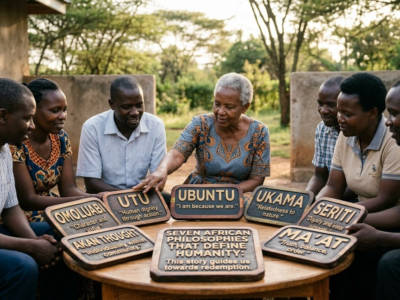
Meta Description: Explore Ubuntu, Ukama, Omoluabi, Utu, Ma’at, Seriti, and Akan thought. Seven African philosophies that redefine what it means to be human.
Africa gave the world more than history. It gave the world a way to think. Long before philosophy became a Western export, African communities built deep, working systems of thought. These systems answered life’s hardest question: what does it mean to be human? Seven of these ideas still stand strong today. Let’s meet them.
Ubuntu: I Am Because We Are
Ubuntu comes from Southern Africa, rooted in Zulu and Xhosa language. Its core line is simple and famous: I am because we are. Ubuntu says a person is not born human. A person becomes human through others. Your kindness shapes your neighbor. Your neighbor’s struggle touches you too.
Ubuntu shows up everywhere in African life. It shows up in shared meals. It shows up in raising a child together as a village. It shows up in forgiveness after conflict. Archbishop Desmond Tutu carried this idea into South Africa’s healing after apartheid. He argued that revenge breaks people further. Ubuntu, he said, mends them instead.
Ukama: Everything Is Connected
Ukama comes from the Shona people of Zimbabwe. The word points to relationship, but not just between people. Ukama ties humans to nature, to ancestors, and to the divine. Nothing stands alone. The river is kin. The forest is kin. The grandmother who passed away last year is still kin.
This idea shapes how Shona communities treat nature. Cutting a tree is not just an environmental act. It is a relational wound. Ukama teaches respect for the natural world, because the community is better for it.
Omoluabi: Character Above All
Omoluabi comes from the Yoruba people of Nigeria. It describes a person of strong, excellent character. The Yoruba believe character is not talk. Character is proof. A true Omoluabi shows respect, honesty, courage, and hard work, without needing praise.
Yoruba elders pass this idea down through proverbs and stories. A person’s reputation, once broken, is hard to rebuild. So the Omoluabi guards their name daily. This philosophy places heavy weight on individual choice, even while living inside community.
Utu: Humanity in Action
Utu comes from Swahili-speaking East Africa. The word means humaneness, or human dignity. Utu insists that virtue is active, not passive. You do not simply believe in kindness. You practice it, every day, in small acts.
Utu shows up in hospitality toward strangers. It shows up in fairness during trade. It shows up in patience with the elderly. Swahili coastal culture, shaped by centuries of trade and exchange, built Utu as a survival tool and a moral compass at once.
Ma’at: Truth Holds the World Together
Ma’at comes from Ancient Egypt, one of humanity’s oldest civilizations. The word means truth, balance, and cosmic order. Egyptians believed the universe rested on Ma’at. Break it, through lies or injustice, and chaos creeps in.
Pharaohs were judged by how well they upheld Ma’at. Ordinary people were taught to speak truth, deal fairly, and respect order in daily life. Egyptian funerary texts even describe the heart weighed against Ma’at’s feather after death. A heavy heart, full of wrongdoing, could not pass judgment.
Seriti: Your Character Casts a Shadow
Seriti comes from the Sotho-Tswana peoples of Southern Africa. The word translates loosely as life force, or moral shadow. Every person carries Seriti. Strong, positive Seriti uplifts a community. Weak or corrupted Seriti drains it.
This idea treats character as contagious. A leader with strong Seriti brings confidence to their people. A leader who lies or steals weakens more than their own name. They weaken the spiritual energy of the whole group. Seriti asks each person to guard their inner life, because it never stays private.
Akan Communitarianism: Freedom With Duty
Akan philosophy comes from Ghana, home to the Akan people. It holds two ideas in balance. Humans are born free. Humans also owe service to their community. Neither idea cancels the other.
Akan thought rejects both extremes. It rejects pure individualism, where a person owes nothing to anyone. It also rejects pure collectivism, where a person has no freedom at all. True fulfillment, Akan philosophers argue, comes from choosing to serve, not being forced to serve.
These Beliefs Point the Way to Humanity’s Redemption
Read together, these seven philosophies tell one larger story. Humans are relational beings. We grow through others, not despite them. Ubuntu and Utu focus on daily human bonds. Ukama and Seriti stretch that bond to nature and spirit. Omoluabi and Akan thought protect individual choice inside communal life. Ma’at holds the whole structure together with truth.
None of these systems are simple folklore. They are working philosophies, tested across centuries, refined through hardship, and still alive in African communities today. The modern world, often fractured and lonely, has much to learn from them.
Africa thought its way through through history, showing that we are not victims, but victors. These seven ideas are proof.
