
Why the ‘Trust Me’ Economy No Longer Works in Nigerian Agriculture
 Contributing Guest
By Cobi-Jane Akinrele
When I first moved to Jos, besides the relatively cool weather, I was taken aback by how trusting everyone was. Some might call it Northern hospitality, but without knowing me very well, I was invited into farmers’ homes for lunch, introduced to their extended family, and given an informal tour of their farm. Despite my early scepticism, I was often reminded that a society underpinned by trust is essential where access to markets, knowledge of globally accepted food and farming practices, and enforcement of government regulation is scarce. If you know me well, you would’ve heard my story about Mr Amos, the well-seasoned Plateau-farmer who taught me why working with smallholders is essential for success.
Cobi: Mr Amos, how do you deal with pests on your produce?
Mr Amos: I don’t have pests. Cobi: Mr Amos, everyone gets pests. Especially those who grow beans. You grow beans.
Mr Amos: Oooooooh. Yes, my neighbour gave me a white powder to pour on my goods.
Cobi: White powder?
Mr Amos: Yes. When I pour it on my goods, everything dies. He smirks.
Cobi: Do you know what the white powder is called? Mr Amos: No, but my neighbour gave it to me. It works.
NB: The white powder is very likely just some form of insecticide.
As superstitious as we can be, as Nigerians, I was surprised that Mr Amos accepted anything from anyone, let alone use it on his source of income. Then again, perhaps his neighbour is a good friend of his.
These moments taught me that trust is both Nigeria’s agricultural superpower and its greatest weakness. It’s what allows farmers like Mr Amos to access inputs and markets in places where formal systems have failed. But here’s the bitter irony, the very relationships that allow Mr Amos to sell his beans are the same ones that ensure he’ll never know their true value, or why they might be rejected at a European port. In 2026, as global markets demand traceability and Nigerian farmers face mounting rejections and outright bans, the “trust-me” economy that once enabled trade now threatens to exclude us from it entirely.
Even when it came to selling produce, I found myself surprised that farmers were more than happy to perch on a nearby bench sipping Maltina while a Dilali (middleman) negotiated the price of their potatoes at a major market in Jos. To me, how did they know they were not going to be cheated? How could they guarantee they were going to get a fair price for their goods? Their hard-earned sweat?
I watched this play out one afternoon at the market. A farmer, let’s call him Baba Musa, had travelled three hours with a small pick-up truck of potatoes. His dilali disappeared into the crowd of traders for nearly an hour. When he returned, Baba Musa simply nodded at the price offered, collected his cash, and ordered another Maltina. I asked him later if he knew the prevailing market rate. He smiled and said, “My dilali has been doing this for twenty years. We are like brothers.” Two stalls away, I overheard a buyer complaining about the quality of potatoes from “these interior farmers who don’t know what the market wants.” Baba Musa’s potatoes. Same batch. The dilali had known but hadn’t said a word.
Trust in both examples I have given allows farmers to access markets or inputs. I am sure, without the relationships they have garnered over the years, this would not have been the case. How many major distributors and aggregators focus on first or last-mile logistics without leveraging these long-established relationships? I, for one, have benefited greatly, professionally and personally, from these trust-based agro-systems while working in Nigeria, but as I have begun to scale and learn more about trade beyond the farm or the village market, I am realising these systems have not provided much rural prosperity. In some instances, they haven’t provided sustainable income for anyone other than the international conglomerate that uses these informal networks to maximise its procurement department.
In this essay, I explore why the “trust-me” economy no longer works in 2026, what damage it’s quietly doing to Nigerian agriculture, and what we may need to replace it with.
What is a “trust-me” economy?
In a previous essay, I made the claim that when it comes to agricultural trade in Nigeria, everyone knows a guy who knows a guy. This, for me, is the “trust-me” economy in action. It is a series of economic activities, be it buying or selling, determined by interpersonal, and sometimes but not always familial relations, without formal agreements beyond spot price. As currently practised, the “trust-me” economy is synonymous with extremely long supply chains. The producer engages with his or her immediate network (Network A) and sells to a local merchant M1. This merchant M1 may sell the produce of 3 or 4 farmers from Network A. Another M2 buys produce from M1 to resell in a larger, but neighbouring town. M3 purchases produce from M2 for sale at a regional trading hub such as Kaduna, Jos, or Minna. M4 purchases this produce from M3 to transport to a larger hub, Kano, Lagos, and Port Harcourt. A procurement officer or local buying agent receives an RFQ for 300Mt so reaches out to his M4 merchants. These procurement officers share the strict specifications with these M4 merchants who state, “my-guy, don’t you trust me? These goods are for sure. Sand-free. Very dry”. This could be true, but how is the M4 merchant sure of this?
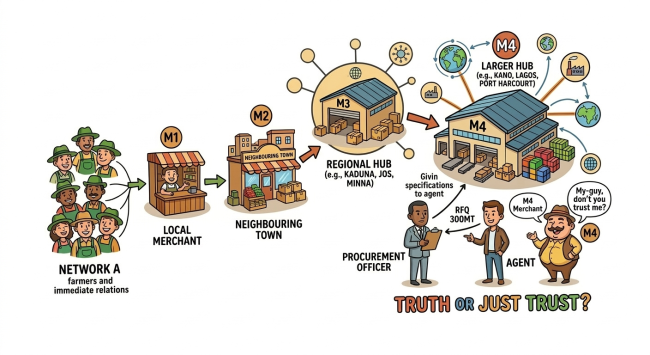
Some might argue that local buying agents (LBAs) avoid this, as many of them live in the states from which one is sourcing. I, for one, know that simply living in a vicinity does not mean you know the source of said produce. Moreover, what incentive does an LBA have to do the groundwork when they can simply call their network?
How we got here
Intermediaries in Nigeria have always constructed a “trust-me” economy by acting as the indispensable bridge between rural producers and urban or global markets where infrastructure is lacking. During the colonial era, European firms relied on local middlemen, village heads, traditional aristocracy, and market leaders to secure cash crops through an “advance” system, lending money to farmers for future produce. These middlemen were often the only individuals within a community with access to capital. When British corporations began to see them as “exploitative moneylenders,” they established marketing boards, a system that early independence leaders continued, replacing cultural middlemen with licensed buying agents (LBAs) who aggregated and transported goods at government-fixed prices. Unsurprisingly, these boards drowned in corruption, and farmers continued to be short-changed.
After the Structural Adjustment Programme of 1986, state-led marketing boards were largely abolished in Nigeria. Many LBAs became private independent traders, working on behalf of Lagos-based manufacturing companies or exporters. The dilali (traditional middleman) still exists, but now he’s just one person in a chain so long that farmers and buyers might as well be on different planets. In some instances, trader-farmer relationships are negotiated based on government-set farmgate prices, but as always, the more interior a producer is, the less awareness they have about the state farmgate price. Moreover, the pressure of immediate needs may force farmers or local traders to sell below farmgate prices. Middlemen here represent access to immediate cash.
The pre-colonial traditional middleman, the dilali, was governed by social and cultural norms with strong ties to those who cultivate the produce they will go on to sell. That accountability has dissolved. Today’s dilali is part of a wider network of traders and buying agents, all varying degrees removed from both farmer and end-buyer, and answerable to no one but profit.
What happens when trust replaces transparency
The problem isn’t that the system assumes trust. It’s that it assumes trust can replace everything else. Here’s what that looks like in practice:
Everyone assumes everyone else isn’t self-serving.
There are several individuals and organisations that benefit from the status quo. When a local merchant can make up to 50% simply from moving produce from the village to the closest town-based market, providing access to market information or buyers may be seen as undesirable. Why would they? If farmers could aggregate among themselves and transport their goods to a point of sale where large-scale buyers could readily purchase their goods, they would. A local merchant will always have a place in the ecosystem, but perhaps the number of hands a product will pass through will significantly reduce, and those with limited value-add beyond knowing people will be out of a career.
Knowledge doesn’t flow, it pools.
Access to markets is not just knowledge of who buyers are or what the prevailing market prices are, but what quality standards, volumes, and sometimes varieties unlock better prices. Every day, I am reminded that many traders do not share this information, if they know themselves, with smallholders or even the merchants they purchase from.
Last year, I sat in a procurement office in Lagos when news came through: another container of Nigerian beans was rejected at a European port. Aflatoxin levels too high. The procurement officer was furious, the exporter was frantic, and somewhere up the chain, four or five middlemen were shrugging. When I asked if the farmers had been told about aflatoxin testing requirements, I got blank stares. “How are they supposed to know?” one trader asked me, genuinely confused. “We just buy what they grow.”
When you hear Nigerian beans have been banned from European markets due to the presence of aflatoxins or pests, it is easy to blame regulatory bodies or farmers themselves. However, how often do individuals across the value chain share the consequences or reasons for the food safety parameters set by international markets? How can Mr Amos prevent aflatoxin contamination when no one in the chain of six people between him and the export container ever mentioned the word “aflatoxin” to him?
Trust works until it doesn’t.
While a dilali is governed by tradition, what is an independent trader governed by? Should the government have a say about local pricing if they are not the ones purchasing the produce, especially in a free-market economy? Who is actually responsible for information asymmetry, and what can be done about it? When things go wrong, when prices crash, when produce is rejected, when farmers get paid half of what they expected, who is accountable? The answer is usually nobody.
Why we can’t just blow it all up
With poor rural infrastructure, limited access to financing for producers, and sporadic state interest in agriculture more broadly, intermediaries in Nigeria are a necessary component of the system. The argument that middlemen are inherently exploitative fails to recognise that it is impractical for all bulk buyers and exporters to engage with thousands, sometimes hundreds of thousands of smallholders themselves directly. Moreover, attempts to do so simply internalise the system’s middleman structure anyway. It is not unheard of for the village head, the most vocal and trusted farmer, or simply the individual who speaks the most English within a farming community, to act as an intermediary between the farming community and a buyer.
The middleman will always exist. The question is: can we make the middleman accountable?
Nonetheless, with rising concerns of traceability, global food standards, and fair pricing, we cannot continue to exist in an ecosystem where producers are so far removed from end-users. Exporters and food manufacturers are increasingly being held responsible for the quality of produce they are selling to the public, so the guarantee of volume alone is not enough to minimise risk. With port rejections, outright bans of produce or heavy discounts applied to poorly graded agricultural produce, it is more important than ever for everyone across the value chain to know, understand, and ensure what is expected of them.
What trust costs us
Let me put this in concrete terms. Nigeria loses an estimated $1.2 billion annually in rejected agricultural exports, that’s money that should be flowing to farmers like Mr Amos, but instead evaporates at ports in Europe and Asia. Meanwhile, countries like Kenya and Ethiopia, with more transparent aggregation systems and better quality controls, are capturing market share in products that Nigeria has grown for generations. In five years, if nothing changes, we’re not just looking at lost revenue, we’re looking at entire farming communities locked out of international markets, forced into subsistence farming or migration to already overcrowded cities.
It’s not the reputation of an individual company that is harmed when poor produce is delivered to an international buyer. It’s all those who send produce from that same country also. It is hard to convince a buyer that not all produce from the same source country will be the same when there are no clear systems in place to ensure that is the case.
What the world can learn from our systems of trust
Middlemen are not inherently bad. However, trust with a lack of transparency, asymmetry of information, and little attention to global standards puts Nigerian agriculture at risk. Those of us who work regularly with global buyers know this already.
What we need is not to eliminate trust, but to build systems where trust is earned and verified. Where information flows both ways. Where a farmer like Mr Amos knows not just that his neighbour’s white powder works, but what it is, why it works, and what the buyer at the end of the chain actually needs. Where the dilali sipping Maltina on the bench isn’t just a gatekeeper, but a genuine partner who benefits when the farmer benefits.
The “trust-me” economy worked when Nigerian agriculture was small, local, and disconnected from global markets. In 2026, with traceability requirements tightening and competitors eating our lunch, trust alone is no longer enough. We need trust plus transparency. Trust plus standards. Trust plus accountability.
Because right now, Mr Amos is still using that white powder. He still doesn’t know what it’s called. And somewhere in Europe, a container of his beans is about to be rejected, and he’ll never know why.
That’s the real cost of the “trust-me” economy. And it’s a bill we can no longer afford to pay.
Published with permission. For more information about Jane Cobi, visit: www.akecollective.com/trade
