
Cost of the Cut: Inside the Hidden Risks At Black Barbershops
 Editorial FN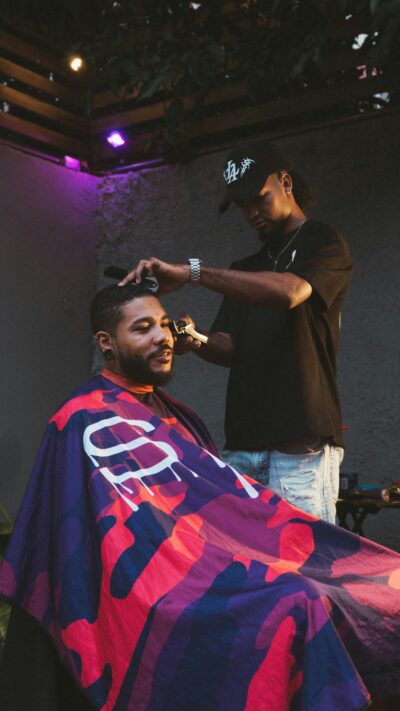
This regular grooming ritual carries grave risks to both the client and the barber (Photo by Siednji Leon on Unsplash)
An investigation into pomades, gels, relaxers, and the everyday chemical and biological exposures affecting barbers and clients in African barbershops, which are mostly unregulated.
The barbershop is more than a haircut spot; it’s where people relax, catch up, and feel at home. But scientists are starting to raise real concerns about what’s in the bottles and jars on the shelf, and what barbers are breathing in and touching every single day.
In 2018, researchers tested 18 hair products commonly used by Black women and kids (relaxers, oils, and lotions) checking for 66 chemicals known to mess with hormones or trigger breathing problems. They found 45 of them. Worse, 84% of those chemicals weren’t even listed on the label. That’s because companies are allowed to just write “fragrance” instead of naming what’s actually in there; sometimes dozens of chemicals hiding behind one word. Barbershop products like pomades, gels, and edge control come from these same companies. And barbers aren’t just using this stuff once in a while; they’re putting their bare hands in it dozens of times a day, every day, for years.
What This Means for Your Health and the Fertility Questions
Many of these chemicals are “hormone disruptors”. They can confuse or throw off your body’s natural hormone signals. A big study following almost 45,000 Black women for over 20 years found that women who used chemical relaxers had a notably higher risk of uterine cancer: the more they used it, and the longer, the higher the risk climbed. Men aren’t off the hook either: exposure to some of these chemicals (called phthalates) has been linked to lower testosterone, especially in boys and middle-aged men. To be fair, the science isn’t 100% settled, as one study found no clear link between relaxers and breast cancer overall, though heavy use of one type was tied to a higher risk of a specific kind. Bottom line: there’s real reason for concern, even if not every question is answered yet.
For women, relaxer use has been linked to earlier puberty, trouble getting pregnant, and fibroids (non-cancerous growths in the uterus that can cause complications). Black women get fibroids at a much higher rate than white women; nearly 1 in 4 versus roughly 1 in 20. Newer research also ties hair straighteners and hair dye to higher fibroid risk. Pregnant women who use these products tend to have higher levels of the same chemicals in their bodies, which have separately been linked to premature birth. For men, the same chemicals that lower testosterone could, over time, affect sperm production too, although scientists are still working out exactly how strong that link is.
Black-Targeted Products And the Skin Problems We look Away From
This isn’t just about how often these products are used, but what’s actually in them. When researchers compared products marketed to Black women against the general market, they found Black-marketed products were consistently more likely to contain harmful chemicals; a gap that’s barely closed in almost 10 years of tracking. Relaxers, straighteners, and dyes (which are used far more in Black hair care) simply don’t have as many equivalents in shops that mostly do basic clipper cuts. Some researchers call this pattern an “environmental injustice.”
Two common but under-discussed skin issues affect Black men at high rates: razor bumps (from shaving) and a scarring bump condition at the back of the neck. Estimates suggest these affect the large majority of Black men. Yet in one study, less than half of barbers could actually recognize the neck condition when shown a photo, and over half said they just avoid cutting the hair of clients who have it, instead of learning how to work around it safely. On top of that, if clippers and razors aren’t cleaned properly between clients, fungal infections can spread from one person’s scalp or beard to the next.
Nobody’s Really Paying Attention
Here’s the uncomfortable part: the government doesn’t require cosmetic ingredients to be approved before hitting store shelves. Companies can hide chemicals behind the word “fragrance” with no real consequences. Harvard’s public health school has pointed out that despite mounting evidence of harm, these products remain barely regulated in the U.S.
If a customer gets exposed once in a while, barbers are exposed constantly because it’s their job. Health researchers have gone as far as classifying hairdressing and barbering as an occupation that’s “probably” linked to cancer, especially bladder cancer. Formaldehyde (a chemical used in some smoothing treatments) is supposed to stay under strict safety limits, but when regulators tested real salons, they found levels five times higher than allowed in one shop. Some manufacturers were even caught not warning salons that formaldehyde was in their products at all. A larger review of studies across 14 countries found that fumes in some shops regularly went over safe limits.
What You Can Actually Do
None of this means skip the barbershop. It means push for better information. If you’re a barber: wear gloves during chemical services, make sure your shop has good airflow, and ask your suppliers what’s really in the products you use. If you’re a client: ask what’s in the pomade or relaxer before it touches your head, don’t ignore razor bumps or scalp irritation, and make sure clippers and combs are actually being disinfected between customers. That’s a basic health rule; and no, you’re not asking for a favor.
The barbershop isn’t going anywhere, and it shouldn’t have to. It just deserves an industry that’s honest about what it’s putting on people’s heads, and in barbers’ lungs.
Based on research from Boston University’s Black Women’s Health Study, the Silent Spring Institute, the Environmental Working Group, OSHA, the International Agency for Research on Cancer, and dermatology literature. For information only.
