
Queens and Mothers: Orompoto, The Woman Who Ruled Old Oyo Empire
 FN Educational Resources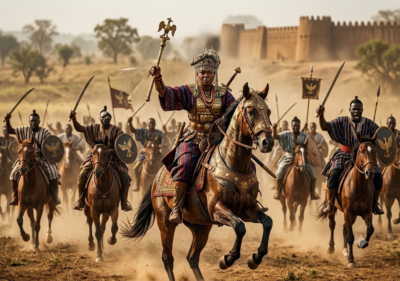
Orompoto convinced the king makers that she had transformed into a man and she lived like one, even leading the troops to war (Imagined by Gemini)
A woman claimed a throne reserved only for men. She built an army that would dominate West Africa for two centuries. Then she died leading it into battle. Her name was Orompoto, and she remains the only woman ever crowned Alaafin, or king, of the mighty Oyo Empire.
A Throne With No Male Heir
Orompoto ruled Oyo during the mid-16th century, roughly from 1554 to 1562. She governed from Oyo-Igboho, the empire’s capital at the time, after Nupe forces had driven the Oyo court from its original home at Oyo-Ile.
She was the daughter of Alaafin Ofinran and the sister of Alaafin Eguguojo, the king before her. When Eguguojo died young, Oyo faced a real problem. Her younger brothers, Ajiboyede and Tella, were still children, far too young to rule. Someone needed to hold the throne steady while the empire faced constant pressure from rival powers.
Orompoto stepped in as regent first. She proved her worth almost immediately, helping drive Nupe forces out of Oyo territory in a hard-fought campaign. That success changed everything. Rather than step aside once a male heir came of age, she declared her intent to rule permanently, determined to protect her dynasty and keep the empire stable against its enemies.
A Council That Said No
Yoruba political tradition reserved the Alaafin’s title strictly for men. The Oyo Mesi, the powerful council of chiefs who checked and confirmed royal power, refused to accept a woman on the throne.
According to Yoruba oral tradition, the chiefs set her a public challenge to prove she wasn’t fit to rule. In response, legend says Orompoto began appearing in male dress, cutting her hair short, and carrying herself like a warrior long before the challenge came. When the moment arrived, she removed her clothing before the council. As she did, oral tradition says male anatomy miraculously appeared, a sign the chiefs read as clear divine backing for her rule. Overwhelmed, they prostrated before her and crowned her king.
Modern historians read this story differently. Most treat it as a symbolic legend, a culturally coded way of explaining how a strictly male, spiritually sacred office came to be filled by a woman. The legend isn’t meant as literal biography. It’s a story Yoruba oral tradition built to make sense of something unprecedented: a woman ruling as Alaafin, full stop, with no earlier example to draw from.
The Queen Who Built an Army
Whatever the succession story’s exact details, Orompoto’s military record stands on firmer historical ground. She introduced cavalry into the Oyo army on a scale the kingdom had never seen, sourcing horses largely through trade with the Borgu people to the north. Some accounts describe her going even further afield, as far as Timbuktu, to secure horses for her new mounted units.
She placed these cavalry forces under the command of the Eso Ikoyi, a specialized order of warrior chiefs. That single decision reshaped Oyo’s military future. Historians credit Orompoto’s cavalry innovation as a major reason Oyo grew into the largest and most feared empire in Yoruba history over the following two centuries.
Her tactics matched her ambition. To hide her army’s movements from enemy scouts, Orompoto had her foot soldiers tie broad leaves to the tails of the cavalry’s horses. As the horses moved, the leaves dragged across the ground and swept away the army’s footprints, erasing any trace of where her forces had been or where they were headed. It’s a small detail, but it says a lot: this was a ruler thinking several steps ahead of her enemies, not just fielding bigger numbers.
Orompoto used that cavalry to real effect. She led forces that successfully pushed back Nupe incursions, restoring territory and prestige the empire had lost in earlier conflicts. Under her, Oyo stopped playing defense and started projecting power again.
Death at the Battle of Illayi
Orompoto didn’t rule from a palace and send others to fight. She led her troops into combat herself, a warrior king in the fullest sense of the word.
That choice caught up with her at the Battle of Illayi, fought around 1562. Yoruba oral tradition describes it as a brutal fight, one where Oyo’s forces suffered heavy losses among their top commanders before eventually securing victory. Some retellings add vivid, almost cinematic detail to how that victory was won, the kind of embellishment oral history often adds to a battle remembered as pivotal.
What’s firmly established: Orompoto was fatally wounded during this battle. She remains the only Alaafin in Oyo’s long imperial history recorded as dying in combat. Her younger brother, Ajiboyede, finally old enough to rule, succeeded her on the throne.
Why Orompoto Still Matters
Orompoto’s reign lasted less than a decade, but her fingerprints stayed on Oyo for two hundred years. The cavalry system she built became the backbone of Oyo’s military dominance across West Africa, long after her death. Few individual rulers, male or female, can claim that kind of lasting military legacy from a single reign this short.
Her story also carries weight beyond military history. She broke a rule that had never been broken before or since in Oyo’s imperial history, taking a title built specifically to exclude her and making it hers anyway. The legend built around that moment, however historians choose to interpret it, reflects just how unprecedented her rule genuinely was.
Orompoto died the way she ruled: on the front lines, refusing to hand her empire’s problems to someone else. That’s rare in any royal history. It’s rarer still for the only woman ever to hold a throne reserved exclusively for men.
Note on the record: much of Orompoto’s story, including her exact reign dates, the details of her succession challenge, and the events at the Battle of Illayi, comes down through Yoruba oral tradition rather than contemporary written record. Specific details vary between retellings, and historians generally treat the more dramatic elements as symbolic rather than literal. The account above reflects the most widely repeated historical estimates and traditions.
#AlaafinOrompoto #OyoEmpire #YorubaHistory #AfricanQueens #WestAfricanHistory #NigerianHistory #PrecolonialAfrica #WomenInHistory
