
Bronze and Wool: Ethiopia’s Scriptures And the Identity of Christ
 Ibironke Babalola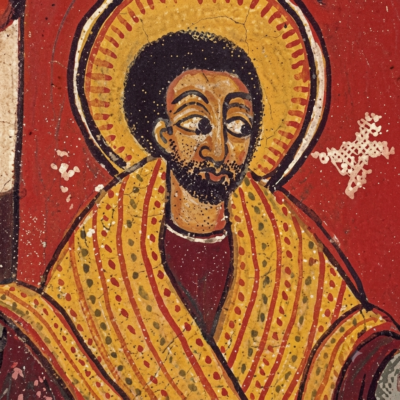
Image of Iyesus (Jesus) reproduced from Iconography of Ethiopian Scriptures (Image: Wikipedia)
For centuries, the world’s dominant image of Jesus has been a European one: fair skin, straight hair, blue eyes, borrowed more from Renaissance Italy than first-century Judea. But the Ethiopian Church has carried its own unbroken witness for nearly two thousand years, and its scripture (wider than the Bible most of the world reads) tells a different story about who Christ was, and whose earthly family he belonged to.
A Bigger Bible, A Bigger Story
The Ethiopian Orthodox Tewahedo Church reads an 81-book Bible, fifteen books wider than the Protestant canon most of the West inherited. Among the books it kept (and the rest of Christendom eventually dropped) are Jubilees (Kufale) and the Book of Enoch (Henok). These texts shaped how Ethiopian Christians understand the entire arc of scripture, from Eden to the end of days, including how they understand Jesus himself.
The Kebra Nagast: Christ’s African Bloodline
Sitting alongside (though technically outside) the biblical canon is the Kebra Nagast, “the Glory of the Kings,” Ethiopia’s great national and royal epic. It tells how the Queen of Sheba traveled to Solomon’s court, bore his son Menelik I, and carried the Solomonic bloodline (and, tradition holds, the Ark of the Covenant itself) back to Ethiopia.
That matters for how Ethiopian tradition understands Jesus. If the Solomonic line runs through Menelik to Ethiopia’s royal house, and the Gospels trace Jesus’s lineage through David and Solomon, then Ethiopia’s kings and Christ share a common root: a family tree that includes the Horn of Africa, not just ancient Israel. It’s worth being honest about what kind of text this is: the Kebra Nagast is a revered national epic, not part of the biblical canon, and its history is legendary rather than documented. But for a millennium and a half, it has shaped Ethiopia’s self-understanding as a nation bound to Christ by blood, not just by faith.
A New Israel, A New Jerusalem
The Kebra Nagast doesn’t stop at bloodline. In its account, when Menelik carries the Ark south out of Zion, Solomon himself declares that God’s glory is moving with it. That the covenant is being transferred to a new elect nation. Ethiopia isn’t described as an admirer of Israel’s God from the outside; it’s written into the story as Israel’s successor, the people now carrying what Jerusalem once carried. The text reinforces this with its account of Ethiopians turning from the worship of sun, moon, and stars to “the Lord God of Israel”; a conversion narrative that seals the transfer.
That claim became solidified over time. In the 12th century, after Saladin’s capture of Jerusalem in 1187 cut Ethiopian Christians off from the real Holy Land, the Zagwe king Gebre Meskel Lalibela carved eleven churches directly into the volcanic rock of the northern highlands and built, quite literally, a New Jerusalem; the name UNESCO’s own World Heritage listing still uses today. A channel at the site is named the River Jordan. One chapel holds a symbolic tomb of Christ; another, a symbolic Golgotha. Ethiopians who could no longer walk to Jerusalem, walked to Lalibela instead.
Interestingly, Lalibela’s “New Jerusalem” was built by the Zagwe dynasty; the very rulers the Kebra Nagast was later written (a century later), to push out of power in favor of the “restored” Solomonic line. So the sacred geography came first; the bloodline theology came after, and rerouted the claim through Solomon and Sheba instead.
There’s a second site worth mentioning, because Jerusalem’s holiness was not just about the city, but about what the Temple held. If Lalibela answers to “New Jerusalem,” Aksum answers to New Zion: the Church of Our Lady Mary of Zion, where Ethiopian tradition holds that the actual Ark of the Covenant still rests, guarded by a single monk for life. Between the two sites, Ethiopia doesn’t just claim a story about Jerusalem, it claims to hold both halves of what made Jerusalem holy: the city, and the Ark that sanctified it.
An Incarnation in Afro-Asiatic Skin
The Gospels of Matthew and Luke (the same texts every Christian tradition reads) are the same texts the Ethiopian Church uses for the Nativity. There’s no separate “Ethiopian” birth story. What is distinct is the cultural lens: the Ethiopian Church has always understood Christ’s incarnation as happening in real, physical, Afro-Asiatic flesh: a Middle Eastern Jewish body, not a Northern European one. Ethiopian iconography has reflected that for centuries, painting Christ, Mary, and the apostles with brown and dark skin long before “representation” was a Western talking point.
The Vision in Revelation
Ethiopia’s canon includes the Book of Revelation (Mäṣḥäfä Reʾyä), and its opening vision of the glorified Christ is striking:
“His head and his hair were white like wool… and his feet like fine brass, as if they burned in a furnace.” (Revelation 1:14–15)
It’s important to be precise here: this passage isn’t unique to the Ethiopian Bible. It’s in every Christian Bible’s Book of Revelation, word for word in substance. What is distinct is how seriously Ethiopian Orthodox theology has taken the image on its own terms (wool-textured hair, skin the color of glowing bronze) rather than smoothing it into the pale, golden-haired “Christ in glory” of later European art. Mainstream biblical scholarship generally reads this vision as symbolic: describing majesty, purity, and judgment rather than a literal physical description. Ethiopian tradition doesn’t necessarily reject that symbolism, but it also hasn’t felt any need to imagine that glorified body as European. Both readings can sit side by side.
Why Does the Ethnicity of Christ Matter?
None of this rests on modern ideas of race, which didn’t exist in the ancient world the way they do now. But it does rest on something real: a 2,000-year-old Christian tradition, rooted in Africa, that has always pictured Christ as one of its own: dark-skinned, African-connected, and never in need of a European face to be believed in.
And yet it’s worth asking the question honestly: does the answer actually matter as much as the fact of the question itself? There’s a familiar instinct in Christian history to want physical proof of Christ: a face, a fabric, a bloodline, something that can be held up as evidence. The Shroud of Turin has drawn that same impulse for centuries: if this cloth is real, for some reason, then Christ was real, and the faith is vindicated. But the Gospels themselves seem to resist that logic. When Thomas doubts the resurrection and demands to see it for himself, Jesus’s answer isn’t a rebuke of his humanity, it’s a redirection: “Blessed are those who have not seen and yet have believed” (John 20:29). The claim of Christianity was never that Christ needed to be verified by cloth, DNA, or complexion. It was that he became flesh at all that God took on a body, any body, in a particular place and time, and lived a real human life inside it.
So the case for Christ’s African features doesn’t have to rest on needing proof to believe. It matters for a different reason: correcting a five-hundred-year-old distortion, in which one culture’s face got mistaken for the only face Christ could have worn. Reclaiming Ethiopia’s ancient witness isn’t about swapping one physical requirement for another. It’s about remembering that the incarnation was never about the shade of the skin in the first place. It was about the God who was willing to put on human form at all.
References
- The Book of Jubilees (Kufale)
- 1 Enoch (Henok)
- Kebra Nagast (“The Glory of the Kings”)
- Revelation of St. John, Ethiopian Orthodox canon (Mäṣḥäfä Reʾyä)
- Gospels of Matthew and Luke, Nativity narratives

.jpg)