
Empire: The Rise and Reign of Mighty Oyo
 Ibironke Babalola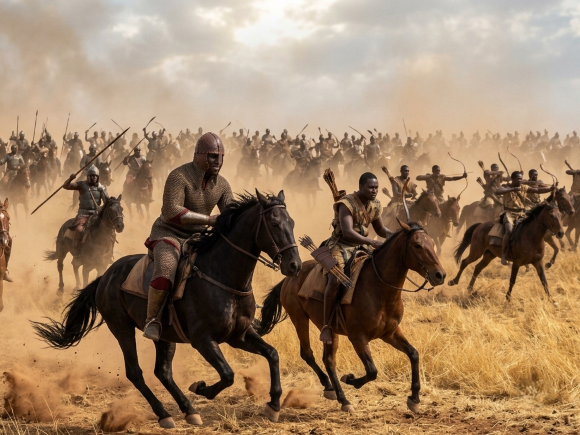
The Oyo Empire stands as one of West Africa’s most formidable historical states. From the 17th to the 18th centuries, this Yoruba powerhouse dominated a vast territory spanning over 150,000 square kilometers. Stretching from the Niger River to modern-day Togo, Oyo built its legacy on terrifying battlefield tactics, absolute economic control, and a sophisticated system of constitutional checks and balances.
Terrifying Battlefield Tactics: The Oyo Cavalry
Unlike its forested neighbors, Oyo mastered large-scale horse warfare on the flat northern savannas. Their military dominance relied on a highly coordinated dual division. The heavy cavalry consisted of elite noble warriors who wore imported chainmail armor and charged with heavy thrusting lances and swords to break defensive lines. Supporting them was the light cavalry, comprised of highly mobile archers and javelin throwers who rode smaller native ponies to harass, flank, and scatter retreating enemies.
To protect these vital military assets, Oyo launched swift, dry-season raids to bypass the southern tsetse fly belt, which carried diseases fatal to horses. When fighting gun-wielding states like Dahomey, Oyo integrated specialized infantry to clear defensive trenches first, clearing a safe path for the devastating cavalry charge.
The Imperial Network: Wealth and Vassal States
At its peak, Oyo controlled critical trade routes and demanded massive annual tributes from its vassal states. The Kingdom of Dahomey, after multiple invasions, eventually yielded to Oyo and paid a steep annual tribute that included guns, coral, cowries, and trade goods. To the coast, Porto-Novo, also known as Ajase, served as Oyo’s primary window to Atlantic trade, allowing direct commerce with European merchants while bypassing hostile coastal groups. Further inland, the Egbado and Central Yoruba kingdoms secured vital trade corridors and formed a buffer zone to safeguard the empire’s northern horse-import pipelines.
Power and Check: The Legendary Kings of Oyo
The ruler of Oyo, known as the Alaafin, ruled alongside the Oyo Mesi, a powerful seven-member council of noble kingmakers led by the Bashorun. This council kept royal authority in check; if an Alaafin became tyrannical or abused his power, the council could reject his rule and force his ritual suicide.
Two monarchs especially highlight the height of Oyo’s glory. Alaafin Ojigi, who reigned in the early 18th century, was a brilliant military strategist who directed the successful campaigns that finally conquered the Dahomey Kingdom, securing Oyo’s absolute dominance. Decades later, Alaafin Abiodun ended a dark era of internal political corruption by defeating the tyrannical Prime Minister, Bashorun Gaha. Abiodun pivoted Oyo toward economic prosperity and peaceful coastal trade, marking the empire’s ultimate golden age.
The Ancestral Connection With Ile-Ife (Spiritual Seniority)
The relationship between Ile-Ife (Ife) and the Oyo Empire was a complex, highly respected, and delicate division of power. To understand their relationship, it is best to look at them as the two complementary pillars of Yoruba civilization: Ife was the spiritual and ancestral heart, while Oyo was the political and military giant.
Yoruba history and mythology dictate that Ile-Ife is the cradle of the world and the original home of all Yoruba people. The relationship between the two states is rooted in a shared royal bloodline.
A Shared Ancestor: Oduduwa, the legendary progenitor of the Yoruba race, ruled Ife. The Founder of Oyo: Oranmiyan, the founder and first Alaafin of Oyo, was a prince of Ife and a direct descendant of Oduduwa. The Spiritual Father: Because of this lineage, the Ooni (King) of Ife was universally revered as the spiritual “father” and custodian of Yoruba religious tradition. Conversely, the Alaafin of Oyo was the political “son” who held the physical sword of war.
The Power Balance: Political vs. Spiritual Sovereignty
While Oyo grew to become a sprawling, wealthy empire with a devastating cavalry, it never politically annexed or militarily conquered Ile-Ife. In fact, Oyo’s military strategy deliberately bypassed the Ife territory.
This peaceful coexistence rested on a sacred, unspoken pact: Legitimacy from Ife: To rule with divine authority, every new Alaafin of Oyo had to receive spiritual validation from Ife. Specifically, they required the Ida Oranyan (the Sword of Oranmiyan, which is a sacred symbol of authority kept in Ife) to complete their coronation. Protection and Non-Aggression: In exchange for this spiritual legitimacy, the Alaafin sworn an oath never to attack or violate the sacred territory of Ife. Ife remained a demilitarized, sacred sanctuary shielded from Oyo’s imperial ambitions.
The Breaking Point and Decline
For centuries, this delicate balance of “spiritual authority in the south” and “military might in the north” kept Yorubaland stable. However, the relationship fractured in the late 18th century, directly triggering the decline of the Oyo Empire.
In 1793, the unstable and desperate Alaafin Awole ordered an Oyo military raid on Apomu, a market town under the territorial custody of Ife, to capture people for the slave trade. By targeting an area associated with the sacred home of Ife, Awole violated his coronation oath.
This sacrilege sparked immediate, severe internal rebellion from Oyo’s own military commanders and noble chiefs (the Oyo Mesi), who refused to support a king who desecrated their spiritual origin. The mutiny forced Alaafin Awole to commit ritual suicide, plunging the Oyo Empire into the devastating civil wars and political fragmentation from which it would never recover.
The Fall and Legacy: From Empire to Heritage
The decline of the Oyo Empire began in the late 18th century, triggered by internal political conflicts and an overreliance on the slave trade. As European trade shifted and the empire’s economic revenues dwindled, tributary states sensed weakness and began to rebel. Crucially, Alaafin Abiodun’s singular focus on economic growth led him to neglect the military, causing the legendary cavalry to slowly disintegrate.
This military decline left Oyo highly vulnerable to external forces. In the early 19th century, the Fon of Dahomey launched successful invasions from the west, while militant Fulani forces pushed down from the north. By 1835, the capital of Oyo-Ile was captured and sacked, forcing the population to flee southward. The refugees founded new cities like modern Ibadan and Abeokuta, while the old empire fractured into smaller factions, making the region easy prey for British colonial forces.
Today, the spirit of the empire survives in Oyo State, Nigeria. The modern city of Oyo, founded in the 1830s as “New Oyo,” remains the official seat of the Alaafin, who continues to serve as an influential custodian of Yoruba cultural and spiritual heritage. Though the monarchy holds no formal sovereign power within the Nigerian state, its historical legacy remains so profound that UNESCO has taken steps to recognize the ancient site and the modern palace as a World Heritage Site.
