
Africa’s Ancient Bones: The Birth of Mathematics
 FN Educational Resources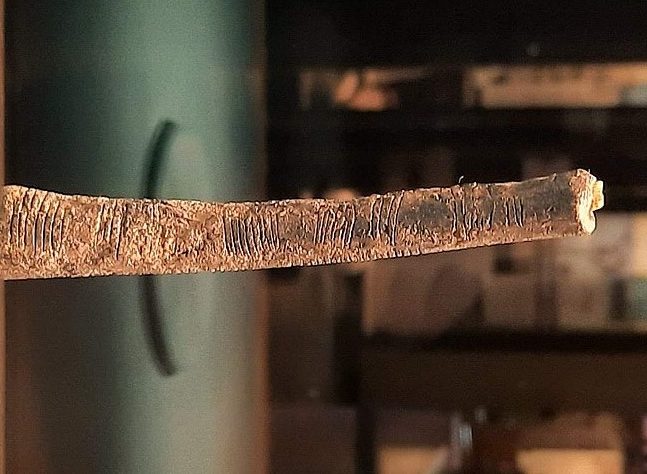
An Editorial Investigation into the Paleolithic Artifacts of Calculation
Discover the world’s oldest mathematical tools. Read how the Lebombo and Ishango bones prove ancient Africans mastered advanced arithmetic and timekeeping.
_________________________________________________________________________________________________________
Did math begin in Europe or Asia? History textbooks often point to Greece or Babylonia. However, archaeological evidence tells a completely different story. The true birth of human calculation occurred deep in Africa tens of thousands of years ago.
Two extraordinary Paleolithic artifacts, the Lebombo Bone and the Ishango Bone, rewrite our understanding of early human intelligence. These tools prove that ancient Africans did not just count. They tracked complex cosmic cycles and solved sophisticated numerical puzzles.
The Lebombo Bone: The Oldest Mathematical Tool
In the 1970s, archaeologist Peter Beaumont discovered a tiny, broken bone in Border Cave. This rock shelter sits in the Lebombo Mountains between South Africa and Eswatini. The artifact dates back an incredible 43,000 to 44,000 years. This makes it the oldest known mathematical tool on Earth.
The Lebombo Bone is a small section of a baboon’s fibula. It features 29 distinct, deliberately carved notches. Researchers quickly noticed a key connection. The number 29 matches the lunar cycle perfectly. This means early humans likely used the bone as a calendar to track the phases of the moon.
Because menstrual cycles align closely with lunar months, anthropologists share an exciting theory. Women may have been humanity’s very first mathematicians. They carved these marks to manage tribal health, pregnancy, and community growth. Even today, San clans in Namibia use identical notched calendar sticks to track time.
The Ishango Bone: The World’s First Calculator
In 1950, Belgian geologist Jean de Heinzelin found another legendary artifact. He excavated a small bone near Lake Edward in the Democratic Republic of the Congo. Known as the Ishango Bone, this tool is roughly 20,000 years old. It now rests in Brussels at the Royal Belgian Institute of Natural Sciences.
Like the Lebombo Bone, this tool is a baboon’s fibula. However, it is far more complex. It features a sharp piece of quartz fixed to one end, suggesting its use as a stylus. Most importantly, it displays sixteen groups of notches arranged in three distinct columns.
These markings show an advanced grasp of numbers. One column contains the four prime numbers between 10 and 20: 11, 13, 17, and 19. Another column shows clear doubling patterns: 3 and 6, 4 and 8, and 5 and 10. These sequences prove that prehistoric Africans understood multiplication, division, and complex arithmetic long before written civilization existed.
A Global Comparison of Prehistoric Math
These African discoveries far outdate similar European findings. For example, archaeologists found the famous Wolf Bone in the Czech Republic in 1936. While that bone shows an organized base-5 counting system, it is only 28,000 to 30,000 years old; making it much younger than Africa’s Lebombo Bone.
| Lebombo Bone | Eswatini / South Africa | ~44,000 Years | Baboon Fibula | Lunar calendar / Cycle tracking |
| Border Cave Sticks | South Africa | ~40,000 Years | Wood & Bone | Resource tallying / Hunting tools |
| Wolf Bone | Czech Republic | ~29,000 Years | Wolf Radius | Base-5 counting / Tallying |
| Ishango Bone | DR Congo | ~20,000 Years | Baboon Fibula | Advanced arithmetic / Primes |
How African Logic Shaped Human History
These ancient tools prove that the foundations of modern technology and science emerged in Africa. Early Africans mastered their environments by tracking lunar phases. This knowledge allowed them to predict weather patterns, map migrations, and schedule planting. Simple marks on bone laid the groundwork for the modern digital age.
Recommended
Ife Bronzes: Africa is Greece…

