
The 40-Year Silence: The Unexplained Omens of 70 CE
 Contributing Guest
By Temitope Obaweya
History often remembers the “what” and the “where”—the smoke over Jerusalem, the clatter of Roman shields, and the final breach of the Temple walls in 70 CE. But for those living within the city in the decades leading up to its fall, history was felt through the “why.”
Years before the first Roman catapult was wheeled into position, the spiritual atmosphere of Jerusalem had shifted. According to meticulous records preserved in the Talmud (Yoma 39b), a series of supernatural anomalies began to occur—signs that suggested the very heavens were “closing the door” on an era.
What makes these accounts scientifically and historically haunting is their consistency: for exactly forty years leading up to the Temple’s destruction, the “miracles” that had defined the Judean identity for centuries suddenly, and inexplicably, ceased.
1. The Crimson Thread that Stayed Red
On Yom Kippur (the Day of Atonement), a crimson wool thread was tied to the horns of the scapegoat. For generations, tradition held that when the goat reached the wilderness, the thread would miraculously turn bone-white—a visual confirmation of divine forgiveness.
But beginning in 30 CE, the miracle stopped. For forty consecutive years, the thread remained a stubborn, haunting red. The Rabbis of the era took this as a direct omen: the “national soul” was no longer finding its traditional path to absolution.
2. The Lamp That Refused to Burn
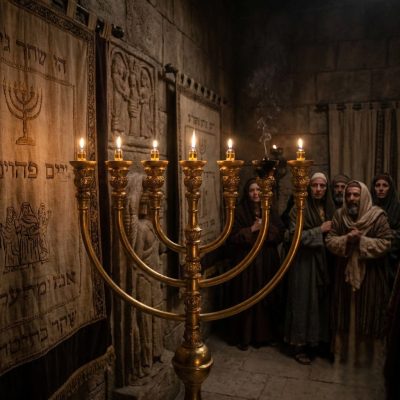
Inside the Holy Place stood the Menorah. Its Ner Ma’aravi (Western Lamp) was the heart of the Temple’s light. Despite containing no more oil than the other lamps, it was known to burn perpetually, often staying lit until the following evening.
However, during those final forty years, the Priests (Kohanim) watched in dismay as the lamp continually extinguished itself.
No matter how much expert care was applied to the fuel or the wick, the “Perpetual Light” seemed determined to go out.
3. The Doors That Opened Themselves
The massive brass doors of the Temple Sanctuary were so heavy they required several men to move. They were the ultimate symbol of the Temple’s “sealed” sanctity.
Then came the “cinematic” omen: the doors began to swing open by themselves in the middle of the night. It was a sight so chilling that Rabbi Yohanan ben Zakkai famously rebuked the doors themselves, citing the prophecy of Zechariah: “Open your doors, O Lebanon, that fire may devour your cedars.” The sanctuary was essentially announcing its own vulnerability.
4. The Lot of the Left Hand
The Yom Kippur service involved the drawing of two lots: one “For the Lord” and one “For the Scapegoat.” Historically, it was a sign of divine favor if the lot “For the Lord” appeared in the High Priest’s right hand.
From 30 CE to 70 CE, the lot “For the Lord” emerged in the left hand—forty times in a row. Statistically, the odds of this happening by pure chance are over 1 in 1 trillion. It was a mathematical impossibility that the Priests could not ignore.
5. The Hunger of the Priests
There was a long-standing “blessing on the bread.” It was said that even a portion of the Showbread the size of a bean would satisfy a Priest’s hunger. By 30 CE, that blessing vanished. The Priests remained hungry, and the “men of action”—the more aggressive or gluttonous among them—began to snatch the bread from their peers.
The spiritual dignity of the Temple was being replaced by base survival.
The 40-Year Intersection: Why 30 CE?
The timing of these omens presents a staggering historical riddle.
In the Jewish view, this forty-year window represented a “generation of warning”—a final call to repent for internal corruption and “baseless hatred” (Sinat Chinam).
Yet, for the historian, another data point is impossible to ignore: 30 CE is the widely accepted date of the crucifixion of Jesus. From a Christian theological perspective, these signs represent the “tearing of the veil”—the moment the old sacrificial system became obsolete. What makes this significant is the source: these omens aren’t recorded in the New Testament; they are found in the Talmud, the foundational text of Rabbinic Judaism. The Rabbis had no motive to validate the events of 30 CE, yet their own records confirm that something fundamental changed in the spiritual machinery of the world that very year.
A Lesson for Today
Whether viewed through a lens of faith, history, or social commentary, these 40 years remind us that nations rarely fall overnight. Long before the walls are breached, the “lamps” go out, the “thread” stays red, and the “doors” swing open. The internal shift always precedes the external collapse.
As we look back at 70 CE, we see a city that was warned by its own miracles—leaving us to wonder what “omens” we might be overlooking in our own era.
About the Author: Temitope Obaweya is a researcher and writer with a passion for historical anomalies and the intersection of ancient texts and modern study.
This article is written based on the author’s independent and original study
