
The Leopard: Sacred Symbol of Ancient Africa
 FN Educational Resources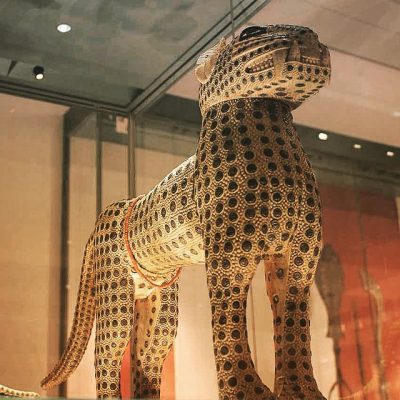
Animals are a distinct feature of the art, religion, and power of precolonial Africa from Igbo-Ukwu’s bronzes to the Ekpe Leopard Society of the Cross River. The leopard did not just prowl Africa’s forests. It loomed large in the culture. And long before European contact, Africa’s ancient civilizations understood that perfectly. They carved its image into bronze. They built secret societies in its name. They wore its skin to speak to the gods.
This is the story of the leopard, one of Africa’s most powerful spiritual symbols.
Forged in Bronze
Around 850 CE, master craftsmen in southeastern Nigeria were creating objects the world had never seen. At Igbo-Ukwu, center of the Kingdom of Nri, metalworkers cast bronze vessels of breathtaking precision. Tiny insects appeared to have landed on their surfaces. They hadn’t been added. They were cast into the original design.
The leopard lived here too. Its image decorated ritual objects belonging to the Eze Nri, the priest-king who ruled not through armies, but through spiritual authority. The leopard marked his power. It marked the boundary between the earthly and the divine. These bronzes predate the famous artworks of Ife and Benin. They reveal trade routes stretching to Egypt. And they carry the leopard’s mark across 1,000 years of history.
Stone Sentinels of the Cross River
Move 150 kilometers east. Stand in a forest clearing in what is now Cross River State, Nigeria. Ancient stone figures face you in a perfect circle. The Ejagham people call them Akwanshi: “dead person in the ground.” Around 300 of these monoliths survive. They are carved from hard basaltic rock. Each one is unique. Their faces show open mouths and elaborate markings. Their forms are unmistakably human — and unmistakably sacred.
The Ejagham who raised these stones built no centralized kingdom. They built something stronger: a civilization held together by shared knowledge, sacred ritual, and one powerful word: ngbe. The leopard.
The Society That Wore the Leopard
The Ekpe (the Leopard Society) changed African history. More than a secret society and long before the invaders arrived, the Ekpe functioned as a legislature, a court, and an executive authority across southeastern Nigeria. It crossed several ethnic line. The Efik, the Ejagham, the Igbo, the Ibibio; all operated within its reach.
Membership did not depend on your tribe. It depended on your rank within the leopard’s hierarchy. Higher initiations unlocked deeper secrets. The most powerful members wore ukara cloths: deep blue textiles blazing with sacred symbols. Those symbols were Nsibidi: one of Africa’s oldest indigenous writing systems. Through Ekpe lodges, knowledge flowed. Trade goods moved. Cultural practices spread. The leopard was the vehicle.
Writing in the Leopard’s Language
Nsibidi is not a simple script. It is a sophisticated system of ideograms that communicated across ethnic and linguistic boundaries. The Ejagham created it. The Ekpe spread it. Communities from the Cross River to Igboland adopted it.
Scholars have found Nsibidi symbols on pottery dating to the 6th century CE. Its roots, carved into the Ikom monoliths, may reach back to 200 CE, or further still. When colonialism shattered much of the old world, Nsibidi survived. It is believed that members of the secret society were systematically hunted and either killed or captured. Enslaved Africans carried it’s symbols across the Atlantic. In Cuba and Haiti, it evolved into the anaforuana and veve symbols still used in Afro-Caribbean spiritual traditions today. The leopard’s writing crossed oceans.
Why the Leopard?
The leopard was the apex predator of the forest. Silent. Elusive. Lethal. It saw everything, revealed nothing. It struck without warning. In West African spiritual thought, these were the qualities of divine authority and supreme perception rather than brute strength. The Heliopolitan high priests of ancient Egypt wore leopard skins to represent their mastery of the stars. The Ekpe initiates of the Cross River wore leopard skins to signal their command of sacred knowledge.
The same symbol. The same meaning. Separated by thousands of miles.
The Ikom monoliths still stand in their ancient circles. Each year, they are repainted: white for peace, blue for fertility, red for bravery. The Ekpe society still exists. The bronze vessels of Igbo-Ukwu rest in museums, still astonishing all who see them. The leopard endures.
These civilizations built no legend with Europe’s help. They achieved it through their own genius – their own sacred science, their own networks, their own vision of cosmic order. The leopard was not just their symbol. It was their declaration.
Africa’s power has always been its own.
