
Fractal Cities: How Ancient African Kingdoms Built with Sacred Geometry
 Ibironke Babalola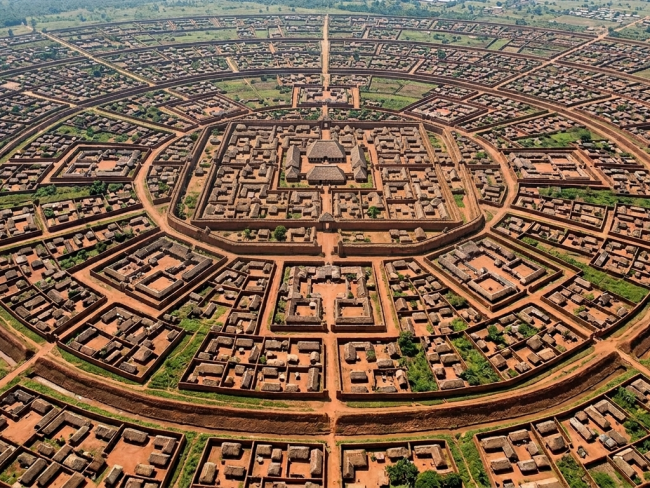
Africa’s ancient builders were intentional when they encoded the universe into stone, mud, and earth. From Benin City to Zimbabwe, ancient African civilisations built concentric cities with a sacred centre.
A previous article explored sacred geometry in African monuments: from the Great Pyramid of Giza to the Ikom Monoliths and Timbuktu’s mosques. But the story does not end there. Across sub-Saharan Africa, entire kingdoms built their cities using fractal mathematics and cosmological design. They did this centuries before European mathematicians formally named these patterns.
The results were breathtaking, but much of it has been lost.
Benin City: The Fractal Capital
At its height, Benin City was one of the most sophisticated urban centres on earth. The Edo people of present-day Nigeria built it not by chance, but by precise, mathematical design. Mathematician Ron Eglash studied the city and found something remarkable. Benin City was a living fractal. Its rooms reflected the shape of its houses. Its houses mirrored the shape of its compounds. Its compounds echoed the shape of the city. The same pattern repeated itself at every scale, from the smallest room to the widest avenue.
The city split into 11 divisions. Each division replicated the structure of the king’s court; a series of interconnected compounds with accommodation, workshops, and public spaces linked by doors and passageways. The king’s authority was coded into the city’s geometry.
At the very centre stood the Oba’s palace. Historical accounts confirm it had occupied that same central spot for at least 700 years. A 17th-century Dutch account described it as a square as large as the town of Haarlem, entirely surrounded by a special wall, divided into many magnificent palaces, houses, and apartments. Wide, straight streets radiated outward from the palace like spokes on a wheel, with royalty and nobility in the inner districts and artisans, warriors, and farmers in the outer quarters.
The earthworks surrounding the city were equally impressive. They stretched over 16,000 kilometres in total: four times the length of the Great Wall of China. They consumed one hundred times more material than the Great Pyramid of Giza. And they followed the same logic: a mosaic of more than 500 interconnected settlement boundaries arranged in concentric circles. It was cosmology embodied by architecture.
The Dogon: Mapping the Family in Stone
In Mali, the Dogon people also built with cosmic intent. Their villages formed concentric layouts that mapped social and spiritual order onto physical space. The layout of a Dogon settlement was a diagram of the universe. Their homes followed a ‘rectangles within rectangles’ pattern. Each nested rectangle represented a person’s place within the family, the community, and across generations. To walk through a Dogon home was to read a story about belonging.
Dogon sculpture reinforced this cosmology. The primordial couple (carved sitting on a stool) showed the earth below and the sky above, united by the Nommo, the mythical ancestor. Architecture and art worked together. Both said the same thing: the world has order, and we live inside it.
Yoruba Architecture and the Four-Sided World
The Yoruba of southwestern Nigeria organised their homes around a central courtyard. This was not simply practical. It reflected what scholars call the Yoruba ‘four-sided worldview’; a belief in balance, stability, and the four corners of existence.
Researchers note that this four-sided philosophy mirrors the square base of the Egyptian pyramids. Different cultures. Different centuries. The same geometric truth.
Yoruba craftsmen also built to connect the visible and invisible worlds. In Yoruba cosmology, life does not end at death, it continues. Objects and buildings served as transmitters. They carried meaning between the living and the ancestral realm. Geometry was the language of that transmission.
Fractals Across the Continent
Benin, Dogon, and Yoruba are not isolated examples. Fractal geometry appears across sub-Saharan Africa wherever researchers have looked. The Nankani people of West Africa built homes as fractal series of cylinders. The scaling followed a person’s life journey: from the mother’s womb, to the birthing room, to the courtyard, to the village, and finally to the world beyond. Architecture was designed to be biographical.
In the Mandara Mountains of Cameroon and in Songhai villages, builders also used circular fractals. In Ethiopia, the ancient churches of Lalibela display fractal cross patterns carved in three iterative layers. In the Cross River region of Nigeria (the same region as the Ikom Monoliths) terracotta vessels bear geometric motifs of concentric circles, spirals, and lozenges.
These patterns were not coincidental. Across cultures and centuries, fractal geometry served as a visual language for identity, cosmology, and cultural memory.
A Universal Human Instinct: Benin Was Not Alone
Look at an aerial reconstruction of ancient Benin City and something immediately strikes you. It does not look uniquely African. It looks universal. That impression is not wrong; and it is one of the most important insights in the entire story of sacred geometry.
Across the ancient world, civilisation after civilisation arrived independently at the same urban idea: a sacred centre, surrounded by concentric rings, with power radiating outward. The geometry was the same. The cosmological logic was the same. Only the culture changed. In ancient Persia, Greek historians described Ecbatana (capital of the Medes) as a city of seven concentric circular walls, painted in different colours, with the royal palace and treasury at the very centre. The resemblance to Benin City’s layout is striking.
In Mesopotamia, Assyrian and Babylonian cities placed the palace and temple complex at their heart, with the city radiating outward in organised districts. Ancient Babylon was described as laid out with the palace at its core and the city spreading concentrically around it.
In southern Africa, the Zimbabwe Plateau civilisation built in concentric stone enclosures. The iconic Great Enclosure at Great Zimbabwe (a massive circular stone wall with a central tower) follows exactly this pattern.
Even Plato’s legendary description of Atlantis follows the same blueprint: concentric circular islands separated by water channels, with the royal palace and temple at the very centre. Whether Atlantis was real or imagined, Plato reached for concentric circles as the natural shape of a perfect civilisation.
This convergence tells us something: The concentric, radially organised city (with a sacred ruler or deity at its centre) was not an invention of any single culture. It was a recurring human instinct. Across Africa, Asia, Europe, and the Americas, people independently concluded that the ideal city should mirror the cosmos: one centre, from which all order flows.
Benin City was not imitating anyone. Neither was Ecbatana, or Great Zimbabwe, or the cities of Mesopotamia. They were all answering the same deep human question: if the universe has a centre, and our king or god embodies that centre, how should we build? The answer, across thousands of years and thousands of miles, was always the same. Build in circles. Put the sacred at the heart. Let everything radiate outward from there.
What the British Destroyed
In 1897, British forces sacked Benin City during the Punitive Expedition. They looted the famous Benin Bronzes. They burned the palace. They tore down the walls. What they destroyed was not just a city. They erased more than a thousand years of living mathematical knowledge; a city whose oldest structures dated back to between 900 and 1200 AD, the same era as Europe’s celebrated medieval cathedrals. It was literally an act of vandalism that robbed the world of an ancient body of knowledge.
NASA’s Landsat 9 satellite, imaging the site in January 2025, can still detect the ghostly arcs of the ancient earthworks as dark green lines in the landscape – vegetation growing in the old moats. But rapid modern urbanisation has buried or destroyed most of what remained. The loss is incalculable. But what survives still speaks.
The Message in the Geometry
Africa’s ancient architects were not primitive builders working by instinct. They were mathematicians who understood fractals, astronomers who read the stars, and philosophers who believed the shape of a building could reflect the shape of the cosmos. And they were part of a worldwide conversation.
From Benin’s concentric earthworks to Ecbatana’s seven walls, from Great Zimbabwe’s stone enclosures to Plato’s mythical Atlantis, humanity has returned again and again to the same sacred geometry. The circle. The centre. The cosmos made city.
Africa’s builders understood this as well as anyone who ever lived. It is time the world remembered that.
