
Queens and Mothers: Nana Asmau, The Royal Who Educated a Nation (Sokoto, Nigeria)
 FN Educational Resources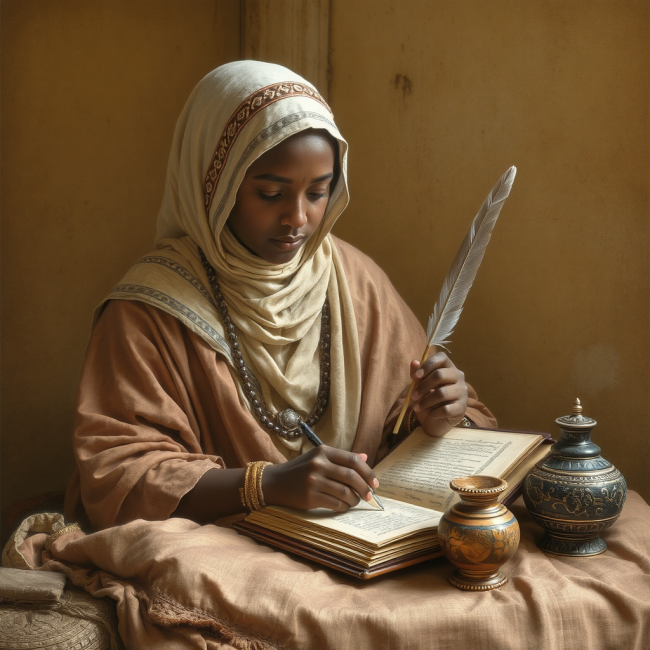
Nana Asmau was a Royal Counsellor, Educator and Poet (Imagined by AI)
A young girl grows up in a war zone. She watches an empire rise around her. Then she picks up a pen and changes history. This is the story of Nana Asma’u.
Born in 1793, Nana Asma’u was a Fula princess, poet, and scholar. She lived through the founding of the Sokoto Caliphate, a powerful Islamic state in what is now northern Nigeria. She was the daughter of Shehu Usman dan Fodio, the Caliphate’s founder. She was also the sister of Muhammed Bello, its second Sultan.
But Asma’u did not just watch history happen. She wrote it, taught it, and shaped it.
A Scholar in Four Languages
Asma’u mastered four languages: Arabic, Fulfulde, Hausa, and Tamacheq, the tongue of the Tuareg people. This gave her a rare gift. She could speak to scholars and farmers alike.
Most religious texts of her time existed only in Arabic. Ordinary people could not read them. Asma’u solved this problem. She wrote in Ajami, a system that uses Arabic script to spell out African languages like Hausa and Fulfulde.
Her output was staggering. She left behind more than 60 surviving works. She wrote poetry, legal treatises, and historical chronicles across four decades. One work, Wakar Gewaye (“The Song of Wandering”), records her firsthand memories of the Fulani wars. Historians still study it today as a primary source.
Building an Army of Teachers
Around 1830, Asma’u launched her boldest project. She called it the Yan Taru, meaning “those who gather together.” It became one of the first large-scale female education networks in African history.
Here is how it worked. Asma’u trained senior women scholars at the Caliphate capital in Sokoto. She called these women jajis. Each jaji studied theology, law, and ethics directly under Asma’u. She composed poems in Hausa and Fulfulde so students could memorize complex ideas easily.
Every jaji received a distinctive hat, a woven malfa, tied with a red turban. This marked her as an official scholar of the Caliphate. Travelers and village leaders recognized the symbol instantly. It gave these women protection and authority as they moved between towns.
The jajis then returned home. They gathered local women in courtyards and taught them to read, pray, and understand their legal rights. They also taught hygiene, childcare, and basic health practices. The lessons spread from village to village, carried entirely by women.
More Than Teachers
The jajis did far more than run lessons. They mediated disputes between neighbors. They supported women through childbirth. They organized aid for widows and orphans during hard times.
In effect, each Yan Taru circle became a small welfare society. Women pooled resources. They looked after the sick. They protected the vulnerable. Education was only the starting point.
A Voice in Government
Asma’u’s influence reached beyond the classroom. She advised her brother, Sultan Muhammed Bello, on matters of state. She exchanged letters with scholars across North and West Africa. She witnessed key military campaigns of the Caliphate and recorded them for future generations.
Few women of her era held this kind of dual role. She was both a spiritual teacher and a trusted political voice.
Nana Asma’u proved that literacy could travel to the doorstep of anyone, regardless of gender or geography. Her model bypassed every barrier that kept women from formal education, distance, language, and social custom.
Her legacy has not faded. Educational networks inspired by the Yan Taru still operate in parts of northern Nigeria today. Scholars across the world now study her poetry and her role in African feminism.
A princess became a teacher. A teacher became a movement. And that movement outlived an empire.
RECOMMENDED
Read about more Queens
