
Empire: Ancient Benin, West Africa’s Lost Metropolis
 FN Educational Resources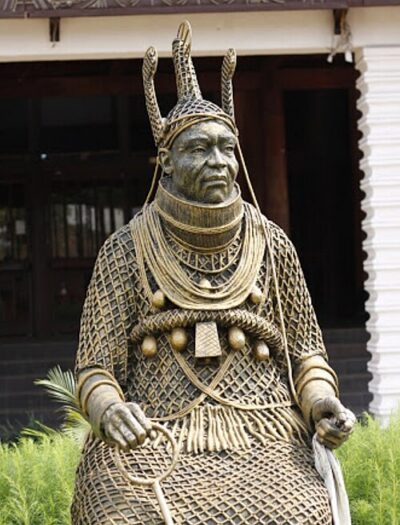
Statue of His Royal Imperial Majesty, the late Oba Akenzua II of Benin Kingdom in full regalia (Image Wikicommons)
The Benin Empire: The West African Superpower Europe Tried to Erase
A city lit its streets at night, centuries before most of Europe managed the same feat. Wide avenues ran straight through it. Bronze plaques covered its royal palace walls, recording centuries of history in metal. This was Benin City, capital of the Benin Empire, one of West Africa’s most advanced states. Although it’s influence reached the modern nation of Benin, this empire ruled from what is now southern Nigeria.
From Sky Kings to Sacred Rulers
Benin’s story starts, according to Edo oral tradition, with the Ogiso, meaning “Rulers of the Sky.” This dynasty governed the region from around the 10th or 11th century onward.
Power shifted around the 13th century. A new line of kings took over, called the Oba. Eweka I became the first Oba in this new system. From that point forward, the Oba held two roles at once: political ruler and spiritual leader. That dual role gave Benin’s kingship a weight most European monarchies never carried. The Oba did not just govern the state. He connected it to the divine.
Ewuare the Great and the Empire’s Golden Age
Everything changed with Oba Ewuare, who took the throne around 1440 after winning a violent civil war against his own brother. Once in power, Ewuare rebuilt the war-damaged capital, reformed the kingdom’s administrative council, and fortified the city with new defensive walls.
He didn’t stop at rebuilding. Ewuare launched military campaigns that expanded Benin’s territory in every direction, turning a regional city-state into a genuine empire. Oral history credits him with over 200 military victories during his reign. By the time he died, Benin stood as the dominant power in the region, and his legacy still echoes today: the current Oba, crowned in 2016, took the name Ewuare II in direct tribute to him.
A City Built to Outlast Empires
Benin’s most staggering achievement wasn’t a single building. It was a network of earthworks: ramparts and moats surrounding Benin City and the villages around it. Estimates put the combined length of these earthworks, boundary traces, and ditches at close to 16,000 kilometers, spread across more than 500 separate but often connected settlement boundaries.
That scale earned recognition from the Guinness Book of Records, which once named the Benin earthworks the largest built before the mechanical era. It’s worth being precise here: this wasn’t one continuous wall like the Great Wall of China. It was a mosaic of interconnected earthworks, built up over centuries by generations of Edo laborers protecting different settlements across the empire’s territory.
Inside those walls, European visitors found a city that stunned them. Sixteenth and seventeenth-century travelers described wide, straight avenues and grand royal palaces. One Portuguese ship captain, writing in 1691, compared Benin City favorably to Lisbon, praising its long straight streets and richly decorated royal buildings. The city also featured tall metal lamps fueled by palm oil, lighting its streets at night, making it one of the earliest cities in the world with organized street lighting.
Bronze That Remembers
Benin’s brass and bronze casters ranked among the most skilled metalworkers in the ancient world. Using the lost-wax casting technique, they produced intricate relief plaques, royal busts, and detailed ivory carvings.
These weren’t just decoration. The plaques covered the walls of the Oba’s palace, working as a visual archive. They recorded historical events, court rituals, and military victories in permanent metal form, functioning much like a written chronicle would in other cultures. Today, these objects are known worldwide as the Benin Bronzes, and they remain some of the most studied and celebrated African artworks in existence.
Trade, Portugal, and a Changing World
Long before Europeans arrived, Benin ran an active regional trade network. Merchants moved pepper, ivory, palm oil, and woven cloth along established West African trade routes, connecting Benin to neighboring kingdoms and peoples.
That changed with the Portuguese, who reached Benin in the late 15th century. Contact grew into formal diplomatic and trade relationships between the two powers. Benin exported ivory, cloth, and, later, enslaved people, receiving brass manillas, firearms, and luxury goods in return. Brass manillas mattered more than most modern readers realize: they weren’t just currency, they were raw material, feeding directly into Benin’s booming bronze-casting industry.
The Fall: 1897 and the British Invasion
Benin’s independence ended in 1897, in a conflict rooted in growing tension over trade dominance in the region. After a British diplomatic mission was ambushed, British forces launched a large-scale military invasion in response.
Benin City fell. British troops captured and burned the capital, ending centuries of independent rule. In the aftermath, soldiers looted thousands of royal bronzes and ivory artifacts from the palace. Many of those objects were sold off, scattering across museums and private collections throughout Europe and North America. That looting still shapes conversations today, as museums and governments negotiate active restitution and repatriation efforts to return these artifacts to Nigeria.
A Living Legacy
The Benin monarchy never fully disappeared. It survives today as a traditional institution within Edo State, Nigeria, carrying forward centuries of cultural and spiritual tradition under the current Oba of Benin.
That continuity matters. Benin’s empire proves that pre-colonial Africa built states with sophisticated governance, urban planning that rivaled European cities, and metalwork technically ahead of its time. Its earthworks, once dismissed or ignored by colonial-era historians, now stand recognized as one of the largest construction projects in human history. Its bronzes, once stolen and scattered, are finally making their way home.
Benin’s story isn’t just about what was lost in 1897. It’s about what an empire built long before that year, and what still endures from it today.
Note on the record: much of Benin’s early history, especially the Ogiso period and the empire’s founding centuries, rests on oral tradition rather than written record, so specific dates and figures vary between sources. The account above reflects the most widely supported historical estimates.

