
Empire: War, Trade, Land, and Legacy of the Zulu Empire
 FN Educational Resources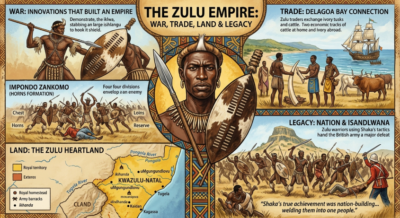
Shaka built the Zulu Empire, its trade, decades of power, and the reach of its influence (Imagined by Gemini)
Picture a clan of fewer than 1,500 people. Now picture that same clan ruling 80,000 square miles of Southern Africa within a decade. That is the story of the Zulu Empire. It rose fast. It fought smart. And it changed the region forever. This rise happened during the Mfecane, a era of massive upheaval across Southern Africa. One man stood at the center of it all: Shaka kaSenzangakhona.
The Man Who Rewrote the Rules of War
Before 1816, the Zulu were minor players. They lived under the Mthethwa Paramountcy. They had little power and less land.
Then Shaka took charge. He looked at how armies fought and saw a problem. Warriors threw spears from a distance. They skirmished briefly, then backed off. Nothing was ever settled. Shaka wanted total victory, not endless raids. So he changed everything. Within ten years, he conquered or absorbed dozens of chiefdoms. His new kingdom stretched between the Pongola and Tugela rivers, covering roughly 80,000 square miles.
Four Innovations That Built an Empire
Shaka’s success rested on four major breakthroughs. Each one solved a real problem on the battlefield.
First, he changed the weapon. Out went the light throwing spear. In came the iklwa, a short, heavy stabbing spear with a broad blade. Its name copies the sucking sound it made when pulled from a wound. This weapon forced warriors into close combat, where Zulu discipline gave them the edge.
Second, he changed the shield. Warriors carried large cowhide shields called isihlangu. Instead of just blocking, they used the shield’s left edge to hook an enemy’s shield and yank it aside. That move exposed the enemy’s ribs for a killing thrust.
Third, he changed the social order. Shaka created the amabutho, an age-based regiment system. Young men and women from many different clans trained together in royal military settlements called ikhanda. Old clan loyalties faded. A new national identity took their place, centered on the king.
Fourth, he changed the formation. Shaka invented the Impondo Zankomo, or horns formation. It split the army into four parts. The chest held veteran fighters who pinned the enemy in place. The horns were fast young warriors who swept around both flanks to trap the enemy completely. The loins sat in reserve, backs turned to the fight, ready to strike wherever the battle needed them most.
Life Inside the Empire
The Zulu state ran on more than spears. Royal homesteads like uMgungundlovu served as political centers, grain stores, and army barracks all at once. Cattle powered the economy. They meant wealth. They paid the bride-price, or ilobolo. They fed families through sour milk, or amasi. A man’s cattle herd told you his status at a glance.
At its peak, the empire fielded 40,000 to 50,000 standing warriors. These men marched 30 to 40 miles a day and could fight the moment they arrived. No European army of the era matched that speed.
Commerce: Cattle at Home, Ivory Abroad
The Zulu economy ran on two tracks. At home, cattle mattered most. Herds measured wealth. They paid the bride-price, or ilobolo. They fed families through sour milk, or amasi. Over time, cattle became more than currency. They turned into markers of spiritual and social standing, prized for status rather than trade.
Beyond the kingdom’s borders, ivory drove commerce. Ivory and cattle were the key items of trade south of Delagoa Bay, and this trade flourished with Shaka’s backing. Delagoa Bay itself, known today as Maputo Bay, had been a trading hub for centuries before Shaka. Portuguese ships had traded there since at least the mid-16th century, often staying up to a year just to fill a ship with tusks.
Trade shaped politics too. Demand for cattle and ivory at Delagoa Bay helped larger states form in the region even before Shaka’s rise, since trade gave chiefs new ways to attract followers and hunting sharpened their armies. The timing was no accident. The same year Shaka took the Zulu throne, 1816, also saw a sharp rise in slave trading out of Delagoa Bay, adding fresh pressure to an already tense region.
How Long the Empire Held Its Power
The Zulu Empire’s rise was fast. Its fall was slow. Shaka built the kingdom’s core territory in under a decade, from 1816 to roughly 1822. That is the sharpest peak: a small clan becoming a regional superpower in the span of one reign. But Zulu power did not stop at Shaka’s death in 1828. The kingdom held its ground as a major regional force for decades under kings Dingane, Mpande, and Cetshwayo. It survived internal succession wars, including the bloody 1856 Battle of Ndondakusuka between royal brothers. It stayed independent and armed.
That long run ended in 1879, at the Anglo-Zulu War. The Zulu win at Isandlwana proved the old tactics still worked. But defeat at Ulundi later that year broke the kingdom’s independence. Britain formally annexed Zululand in 1887 and folded it into Natal in 1897.
So the numbers tell two different stories. As a territorial force at its peak, the empire’s rise took less than ten years. As a recognized regional power, it held influence for over six decades.
Where the Empire Stood: Modern-Day Borders
The land Shaka directly ruled maps closely onto today’s KwaZulu-Natal province in South Africa. That was the empire’s true core, the ground its kings governed and taxed.
Its reach went further, through alliance, tribute, and trade to Eswatini (Swaziland) and parts of Mpumalanga, South Africa acted as buffer zones and tributary areas. It reached Southern Mozambique, connected to the empire through the Delagoa Bay trade route and, later, through the Gaza Kingdom, a state founded by Soshangane, a general who fled Zulu conflict and built his own power base further north. The Free State and other parts of the South African interior also felt the empire’s indirect force through the Mfecane, the wider wave of conflict and displacement the Zulu wars helped set off.
The empire’s direct rule stayed concentrated in KwaZulu-Natal. Its wider footprint, stretching indirectly into Zimbabwe, Zambia, and Malawi through refugee groups like the Ndebele, reflects the fallout of war and migration, not territory the Zulu state actually governed. Many historians now argue that older, colonial-era accounts overstated how much of that chaos traced back to Shaka alone.
A Legacy That Outlasted the Battlefield
European writers often focused only on Zulu military power. That misses the bigger story. Shaka’s true achievement was nation-building. He took groups like the Ndwandwe, Mthethwa, and Qwabe, each with its own language and customs, and welded them into one people with a shared culture and pride.
That legacy proved its strength decades later. In 1879, at the Battle of Isandlwana, King Cetshwayo’s warriors used the same horns formation Shaka had designed. They handed the British Empire one of its worst defeats ever suffered against a force armed mainly with traditional weapons.
The Zulu state was never just an army. It was proof that discipline, unity, and bold new ideas can turn a small clan into a lasting nation.
Note on the record: historians still debate exact figures for the Zulu Empire’s territory, army size, trade volume, and death toll from the Mfecane, since written records from the era are limited and often filtered through colonial-era accounts. The numbers and borders above reflect the most widely cited estimates.
